
Finding Local Fire Safety Equipment Suppliers
July 21, 2026
Annual Fire Extinguisher Inspection Tags: Spot a Fake Before FDNY Does
July 23, 2026
Summary:
Here’s a scenario that plays out more often than most business owners expect: you paid for the annual inspection, there’s a tag on the extinguisher, and you still walked away from an FDNY visit with a violation in hand. It feels unfair. But the inspector wasn’t looking for just one thing—they were looking for a complete documentation trail, and somewhere in that trail, something was missing.
Fire extinguisher maintenance in New York isn’t a single event. It’s a system of records, each one distinct, each one auditable on its own. Understanding what those records are—and who’s responsible for keeping them—is the difference between passing an inspection and explaining a citation to your insurance carrier.
Fire Extinguisher Inspection Log: The Record Most Businesses Don't Know They Own
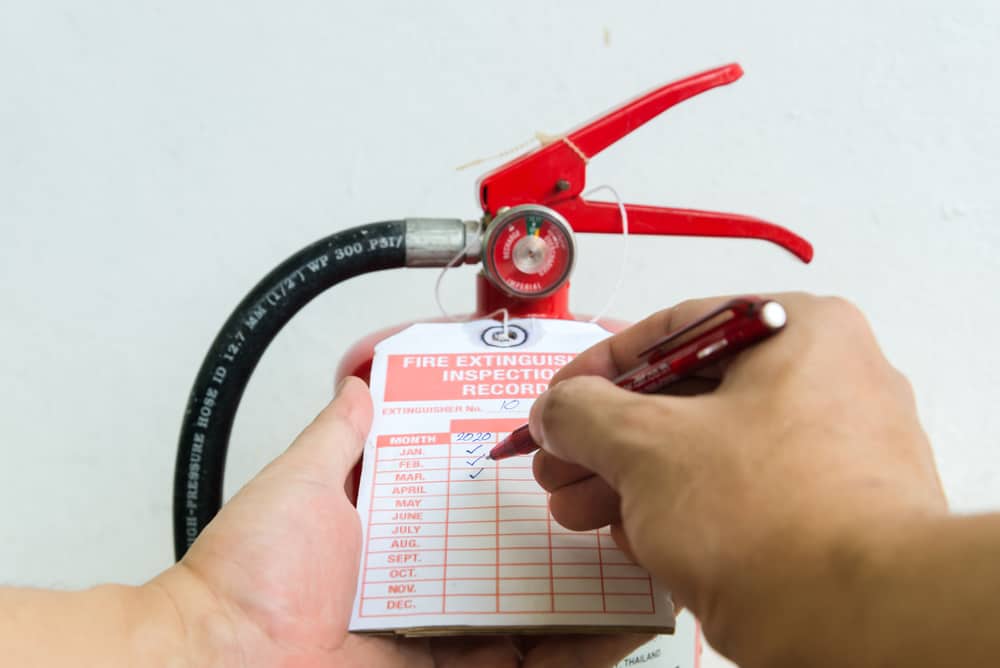
When most people think about fire extinguisher compliance, they picture the tag hanging off the handle. What they don’t picture is the monthly inspection log—a separate, written record that building owners and managers are responsible for maintaining themselves, not the service company.
NFPA 10 §7.2.4 requires that at least 12 consecutive months of monthly visual inspection records be kept on file. That means every month, someone on your staff needs to check the extinguisher—confirm the gauge is in the green, the seal is intact, the unit is accessible and properly mounted—and document it. Date, initials, findings. That’s Record #1, and it lives in your office, not on the extinguisher.
FDNY inspectors check this log. If it’s missing, incomplete, or only covers a few months, that’s a citable violation—even if your annual service was performed on time and your tag is current.
Fire Extinguisher Monthly Inspection Tags: What Goes on the Unit vs. What Goes in the File
There’s a practical distinction worth understanding here, because it trips up a lot of business owners. NFPA 10 allows monthly inspection documentation to live in one of three places: a tag attached directly to the extinguisher, a paper checklist maintained on file, or an electronic recordkeeping system. Many businesses assume the tag handles everything. It doesn’t.
Fire extinguisher monthly inspection signs and tags—the small paper or plastic tags that hang alongside the annual service tag—are designed to capture each month’s initials and date as the person doing the check works through the unit. They’re useful, but they have limits. Tags get damaged. They fall off. They get replaced when the extinguisher is moved. And when an FDNY inspector asks to see 12 months of documentation, a tag with three legible entries and nine smudged ones isn’t going to hold up.
The more reliable approach is a maintained log kept separate from the extinguisher itself—something that doesn’t depend on the physical condition of a piece of cardboard hanging in a storage room. In a restaurant kitchen in Queens or a warehouse in Suffolk County, that tag is going to take a beating. A log in a binder or a digital system won’t.
What the monthly check actually covers isn’t complicated: Is the gauge reading in the operable range? Is the tamper seal intact? Is the safety pin in place? Is the extinguisher visible, accessible, and not blocked by merchandise or equipment? Is there any obvious physical damage? These are visual checks that don’t require certification—but they do require documentation. That’s the part most businesses skip, and the part FDNY inspectors specifically look for when they walk in.
For businesses with multiple extinguishers across multiple floors or locations, this quickly becomes a system problem. Tracking monthly checks across 20 units in a Manhattan office building or a multi-tenant commercial property in Nassau County without a structured log is how gaps happen. And gaps, in FDNY’s view, are violations.
Fire Extinguisher Service Tags: Why the Tag on Your Extinguisher Has to Be the Right Tag
Record #2 is the annual service tag—what most people think of when they picture fire extinguisher compliance. But in New York City and Long Island, not just any tag counts. Since October 1, 2019, every fire extinguisher in NYC must display an FDNY-issued numbered tag. These aren’t generic stickers. They’re security-enhanced, individually numbered tags that only FDNY-approved companies are authorized to purchase and affix.
The tag contains the servicing company’s name, address, phone number, company ID, and the date of service. It also carries a QR code that allows an FDNY inspector—or anyone else—to scan and verify the service record on the spot. If your extinguisher has a tag from a company that isn’t on the FDNY’s approved list, that tag is non-compliant. It doesn’t matter if the physical inspection was done correctly. The tag itself is the proof of compliance, and a non-FDNY tag isn’t proof of anything.
This matters because fraudulent fire extinguisher services are a documented problem in the New York market. The FDNY tag system was introduced specifically because unscrupulous companies were providing bogus inspections and attaching counterfeit documentation—leading to fires, injuries, and significant property damage. The numbered tag system exists to make fraud detectable. If your current service provider isn’t FDNY-approved, you could be holding a violation you don’t know about yet.
We are FDNY-approved to purchase and affix official FDNY-issued numbered tags. That approval is verifiable on FDNY’s public list. When we service your extinguisher, the tag we leave behind is the one that holds up in an audit—not a sticker, not a generic label, but the actual numbered tag that satisfies 3 RCNY 115-02.
Fire Extinguisher Maintenance Records Beyond the Annual Inspection
Most businesses think the annual inspection is the finish line. It’s actually the midpoint. NFPA 10 establishes a four-tier maintenance schedule, and the annual inspection is only one tier. The other two—a 6-year internal examination and a 12-year hydrostatic pressure test—generate their own distinct records, and those records are audited independently.
If you’ve had the same extinguisher for more than six years and can’t produce documentation of an internal maintenance inspection, that’s a compliance gap. If it’s been more than 12 years and there’s no hydrostatic test stamp on the cylinder, the unit may need to come out of service entirely. Neither of these milestones is optional, and neither is automatically tracked by your annual service provider unless you have a relationship built around that kind of long-term accountability.

What Is 6-Year Fire Extinguisher Maintenance and What Record Does It Leave?
Every six years, stored-pressure fire extinguishers that require a 12-year hydrostatic test—which includes the ABC dry chemical units you’ll find in most commercial spaces—must be emptied and subjected to an internal examination. This is Record #3, and it’s the most commonly skipped maintenance requirement in the entire NFPA 10 framework.
The 6-year internal exam involves discharging the extinguisher, inspecting the internal components for corrosion, damage, or deterioration, and verifying that the unit is still serviceable before recharging it. If the internal components show signs of failure, the unit gets replaced. If everything checks out, it gets recharged and returned to service.
What makes this record distinct—and what makes it auditable—is the physical label NFPA 10 §7.3.2.2.1 requires to be affixed to the extinguisher after the exam. It must be a metallic label, minimum 2 inches by 3½ inches, documenting the date of the internal maintenance and the company that performed it. This is not the annual service tag. It’s a separate label, and its absence is a separate violation.
The reason this requirement gets skipped so often is straightforward: annual service providers don’t always flag it. If your service company isn’t tracking the age and maintenance history of your specific units, the 6-year milestone can pass without anyone noticing. For a restaurant in Deer Park or a retail space in Hempstead that’s been operating for a decade with the same extinguishers, this is a real exposure. The equipment may have passed every annual inspection and still be carrying a documentation gap that shows up the moment an auditor asks to see the metallic label.
The 12-Year Hydrostatic Test and What Happens to Records When You Change Service Providers
Record #4 is the hydrostatic pressure test stamp—a physical mark embossed or attached to the cylinder itself that documents when the extinguisher’s pressure vessel was last tested. For ABC dry chemical extinguishers, this test is required every 12 years. CO2, water, foam, and wet chemical extinguishers require it every five years. Non-rechargeable extinguishers must be removed from service entirely 12 years from their manufacture date, regardless of condition.
The hydrostatic test verifies that the cylinder can still safely contain pressure under stress—a failure point that visual inspection can’t detect. If the test stamp is missing or the date has lapsed, the extinguisher is non-compliant. It doesn’t matter how clean the gauge reads or how intact the seal is.
Record #5 is the one that catches businesses off guard the most: the service company’s own records. Under the NYC Fire Code, companies performing fire extinguisher service in New York are required to maintain records of all work performed for a minimum of three years. This is more stringent than OSHA’s one-year minimum.
Why does this matter to you? Because if there’s ever a dispute about whether service was performed—during an insurance claim, a legal proceeding, or an FDNY audit—those company-side records are the backup documentation that confirms your compliance history.
The problem arises when businesses switch service providers. If you move from one company to another and the previous provider’s records aren’t transferred or accessible, you may have a gap in your audit trail that you can’t fill. This is particularly relevant for businesses in Nassau and Suffolk Counties that have cycled through multiple service providers over the years—a common pattern in a market where low-cost operators come and go. A long-term relationship with a single, accountable provider isn’t just more convenient. It’s a documentation strategy.
What to Do If You're Not Sure Your Fire Extinguisher Records Are Complete
If you read through this and realized you’re not certain where your monthly log is, or whether your 6-year label exists, or whether your service company is actually FDNY-approved—that’s worth acting on before an inspector asks the same questions.
The five records that matter are the monthly inspection log, the annual FDNY-issued service tag, the 6-year internal maintenance label, the 12-year hydrostatic test stamp, and the service company’s retained records. Each one is a separate audit target. Passing on four out of five still means a violation.
We’ve been working with businesses across Long Island and all five boroughs for over 35 years. We know what inspectors look for, we know the specific FDNY requirements that apply in New York, and we’re here when you need us—same day, if that’s what the situation calls for. If you want to know where your documentation actually stands, reach out to M&M Fire Extinguishers Sales & Services, Inc. and we’ll help you figure it out.
Related posts