OSHA Fire Extinguisher Placement Rules, Decoded
September 11, 2026
New York Fire Extinguisher Service Cost Guide for 2026
September 17, 2026
Summary:
You opened the notice. Maybe it came during an FDNY inspection, maybe it showed up in the mail a few days later. Either way, you’re now holding a fire extinguisher violation and wondering how serious this actually is. The short answer: serious enough to act on today. The longer answer is what this page is for. We’ll walk you through what the fines look like, how the 35-day correction window works, what it actually takes to clear a violation the right way, and why getting the extinguisher serviced is only half the job.
What a Fire Extinguisher Violation Actually Costs You
The fine listed on your notice is not necessarily the final number. For a first-time fire extinguisher violation in New York City, fines run $250 to $1,000 per extinguisher — not per inspection event, per unit. A business with five non-compliant extinguishers is looking at $1,250 to $5,000 on a single notice before anything escalates.
Repeat violations push that range to $1,000 to $5,000 per extinguisher. And if the violation goes uncorrected past the deadline, per-diem penalties of $100 to $1,000 per day can start stacking on top of the base fine. The number on the paper is the floor, not the ceiling.
Fire Extinguisher Inspection Cost vs. the Fine
A professional annual fire extinguisher inspection in New York typically runs $40 to $100 per extinguisher. That’s the cost of staying compliant. Compare that to a first-time violation fine of $250 to $1,000 per unit, and the math isn’t complicated. The inspection is always cheaper than the penalty — by a wide margin.
We offer one-time service at $99, which covers the inspection and puts you on the right side of compliance without locking you into a monthly plan. Over a year, staying current with annual inspections costs far less than fighting a single violation.
The reason the cost comparison matters right now is that you’re not just weighing inspection fees against fines anymore. If you miss the correction deadline, you’re looking at an OATH hearing, potential default judgments at maximum fine levels, and per-diem penalties that keep accumulating until the violation is resolved. The inspection cost becomes almost irrelevant at that point. What matters is getting the correction done — and documented — before the window closes.
For businesses across NYC and Long Island, the enforcement environment is active. FDNY issued over 22,000 violations across New York City in 2024 alone. This isn’t a rare event. It’s a routine part of operating a commercial space here, and the businesses that handle it quickly are the ones that avoid the bigger financial hit.
What Happens If You Miss the 35-Day Deadline?
The 35-day window is the most important number in your violation notice, and it’s also the most misunderstood. From the date the violation was issued — not the date you received it — you have 35 calendar days to correct the violation AND have a notarized Certificate of Correction received by FDNY’s Administrative Enforcement Unit. Both things have to happen. Correction alone doesn’t close the case.
If you fix the extinguisher but don’t file the Certificate of Correction in time, you still end up at an OATH hearing. If you miss the hearing, a default judgment is entered against you at the maximum fine level. There’s no appeal process for a default — the judgment stands.
First-time violators who correct the violation and file the Certificate of Correction within 35 days can avoid paying any fine at all, provided the violation isn’t classified as hazardous. That’s how the system is designed. FDNY wants businesses to come into compliance, and they’ve built in a path to do that without financial penalty. But that path closes at day 35.
The dismissal rate for fire code violations at OATH is around 12%. Fighting the violation at a hearing is rarely the right move. Correcting it and filing the paperwork is almost always the faster, cheaper, and more reliable path. By the time a business owner has spent time preparing for a hearing, they’ve usually burned through most of the correction window anyway.
The Certificate of Correction has to be signed, notarized, and submitted to the Administrative Enforcement Unit at 9 MetroTech Center in Brooklyn. It can also be submitted through the FDNY Business portal online. But it has to be received — not just mailed — before the deadline. Postmarked isn’t good enough.
Fire Extinguisher Repair and What "Correcting" the Violation Actually Means
Here’s where a lot of business owners get tripped up. They call a service company, get the extinguisher looked at, and assume the violation is handled. It isn’t — not automatically. Correction means the physical problem has been fixed AND the documentation to prove it is in order AND the Certificate of Correction has been filed with FDNY.
Fire extinguisher repair in the context of a violation might mean recharging a unit that’s lost pressure, replacing a broken valve or hose, performing a six-year internal maintenance check if the unit is due, or replacing the extinguisher entirely if it’s structurally compromised or fails hydrostatic testing. What it always means is that the unit has to be returned to full FDNY-compliant status — not just functional, but documented and tagged.
Fire Extinguisher Recertification: Why the Tag Is Only Part of It
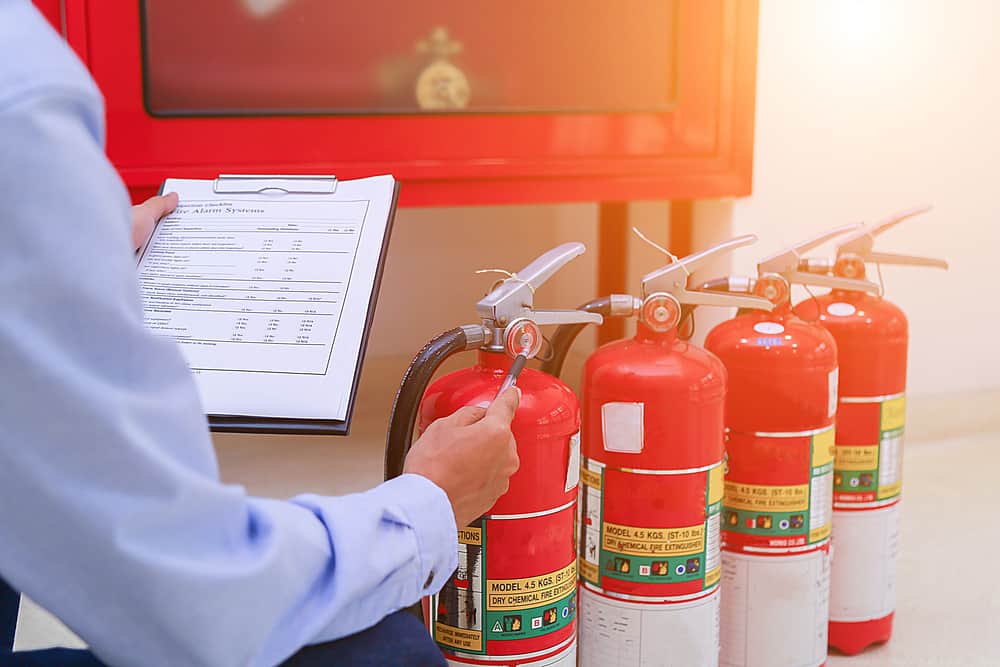
Since 2019, all fire extinguishers in New York City must carry FDNY Smart Tags — a specific, FDNY-mandated tag that can only be issued by companies holding the proper FDNY portable fire extinguisher servicing company certificate, with technicians who carry an FDNY-issued W62 photo ID. This isn’t a formality. It’s the legal proof that the inspection was performed by a qualified provider.
Fire extinguisher recertification isn’t just affixing a sticker. It’s the combination of physical service, proper documentation of what was done, and the issuance of a valid Smart Tag that FDNY will recognize when they review your Certificate of Correction. If the company that serviced your extinguisher isn’t FDNY-certified, the tag they put on it won’t satisfy the violation. You’ll have paid for service that doesn’t count.
The NYC Department of Investigation has uncovered cases where companies attached inspection tags bearing another company’s name — fraudulent records that left business owners exposed even after paying for service. The FDNY Smart Tag system was created specifically to address this. It makes it difficult for unlicensed companies to produce documentation that holds up under review.
When we service an extinguisher as part of a violation correction, we provide the full documentation package — what was inspected, what was repaired or replaced, the valid FDNY Smart Tag, and guidance on completing and filing the Certificate of Correction. The physical work and the paperwork are part of the same job. That’s what actually closes the violation.
We handle violation corrections across Manhattan, Brooklyn, Queens, the Bronx, Staten Island, Nassau County, and Suffolk County. You’re not coordinating with different vendors for different boroughs. One call, one provider, one documented correction.
Common Reasons Fire Extinguishers Fail Inspection in New York
Understanding why violations happen is useful — not to avoid blame, but because it helps you know exactly what needs to be corrected before the Certificate of Correction is filed. The most common triggers we see across New York City and Long Island are low or out-of-range pressure gauge readings, missing or broken tamper seals, expired inspection tags, physical damage or corrosion on the shell or hose, and extinguishers that are overdue for six-year internal maintenance or hydrostatic testing.
Placement violations are also common and easy to overlook. NFPA 10 requires that every point in a commercial building be within 75 feet of a fire extinguisher. A business that has reorganized its floor plan, added storage, or expanded into a new space may have inadvertently created a coverage gap that an inspector flags. The fix isn’t always a new extinguisher — sometimes it’s repositioning what you already have.
Extinguisher type is another one. A restaurant kitchen that’s running a commercial fryer needs a Class K extinguisher. If an inspector finds an ABC dry chemical unit covering that hazard, that’s a violation. The correction requires the right type of extinguisher in the right location, not just a recharged version of the wrong one.
The reason this matters for your violation is that “correcting” the violation means addressing the specific condition cited — not just having an extinguisher on the wall with a fresh tag. FDNY inspectors who review Certificates of Correction are looking to confirm that the cited deficiency no longer exists. If the correction doesn’t directly address what was cited, the CCR can be rejected, which restarts the clock on the penalty process.
We’ve been doing this for 35 years across Long Island and the Five Boroughs. When we come out to a violation call — often the same day — we’re looking at the specific citation, correcting the exact deficiency, and making sure the documentation reflects that. That’s what gets the violation closed.
How to Clear a Fire Extinguisher Violation in NYC or Long Island Before It Gets Worse
The path forward is straightforward, but it has to move fast. Get the extinguisher inspected and corrected by an FDNY-certified provider, make sure the Smart Tag is valid and the service is documented, and file the notarized Certificate of Correction with FDNY before day 35. Do all of that, and a first-time violation may cost you nothing in fines.
Wait, and the options get narrower. The OATH hearing becomes mandatory, fines are assessed, and the per-diem penalties keep running until the violation is resolved. The violation also appears in DOB BIS records, which can complicate property sales, refinancing, and Certificate of Occupancy applications down the line.
If you’ve received a fire extinguisher violation and you’re not sure how much time you have left, call us today. M&M Fire Extinguishers Sales & Services, Inc. has been handling violation corrections across New York City and Long Island for over 35 years, with same-day service available and the FDNY certifications required to make the correction stick. We’re available 24 hours a day — because the clock on your violation doesn’t stop at 5 o’clock.
Related posts