
Got a Fire Extinguisher Violation? Here’s What Happens If You Wait
September 17, 2026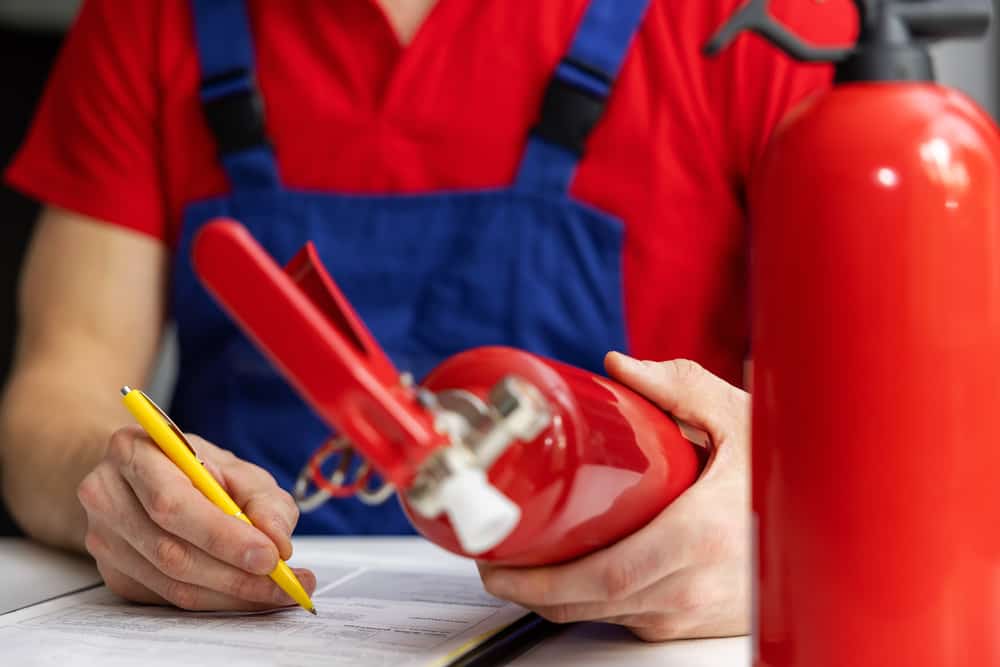
Fire Extinguisher Tags in Nassau County: What Drives Restaurant Costs
September 18, 2026
Summary:
If you’ve searched for fire extinguisher service pricing in New York and come up empty, you’re not imagining things. Most companies in this market don’t publish what they charge — you have to call, wait for a quote, and hope the number you get matches what shows up on the invoice. It’s frustrating, and it makes it nearly impossible to budget or comparison-shop.
This guide changes that. We’re laying out what fire extinguisher service actually costs in New York — across all service types, for both NYC and Long Island — so you can walk into any conversation knowing what’s fair. Let’s start with the service most businesses need every year.
Fire Extinguisher Inspection Cost in New York
The annual inspection is the baseline — it’s what NFPA 10 requires every year, and it’s what FDNY enforces in the five boroughs. A certified technician physically checks each unit: pressure gauge, pull pin, tamper seal, hose condition, mounting bracket, and visible signs of damage or corrosion. At the end, they attach a dated tag documenting the inspection.
In New York, professional inspections typically run $40 to $100 per visit, depending on how many extinguishers you have and what types they are. Specialized units like wet chemical or Halotron systems can cost up to $300 to inspect due to the expertise and equipment involved. If you have a single extinguisher in a small office, you’re looking at the lower end of that range. A restaurant with a commercial kitchen and multiple units will land higher.
Fire Extinguisher Inspection Price: What Drives the Difference in NYC vs. Long Island
The same annual inspection that costs $50 in a suburban strip mall on Long Island might cost more in Manhattan — and there are real reasons for that. Urban service calls in the five boroughs come with higher labor rates, parking costs, building access complexity, and the time it takes to coordinate with building management in a high-rise. A technician servicing 30 units spread across three floors of a commercial building in Midtown is dealing with freight elevator scheduling and security check-ins before they’ve touched a single extinguisher. That overhead gets factored into the price.
On Long Island — Nassau County, Suffolk County, and the surrounding suburbs — service calls are generally more straightforward. Properties are more accessible, travel time between jobs is more predictable, and there’s less logistical friction. That said, some providers charge minimum service call fees for locations further out in Suffolk County, so it’s worth asking upfront.
There’s another pricing factor that’s specific to New York City and doesn’t apply anywhere else: the FDNY standardized tag requirement. Since 2019, every fire extinguisher in the five boroughs must display an FDNY-issued tag — not a generic service sticker, but an official tag that only FDNY-approved companies are authorized to purchase and attach. If a company can’t provide that tag, their inspection is effectively worthless in NYC. You’ll still fail an FDNY inspection, and you’ll still face a violation. So when you’re comparing prices, make sure you’re comparing apples to apples — a cheaper quote from an unlicensed provider isn’t actually a deal.
The quantity of extinguishers also plays a significant role. Most providers offer lower per-unit pricing when servicing larger quantities in a single visit. A facility manager overseeing a building with 20 or 30 units will typically pay less per extinguisher than someone with a single unit in a small retail space. If you manage multiple properties, bundling service visits across locations — or combining fire extinguisher inspections with alarm or sprinkler inspections — can reduce your overall cost by 15 to 20 percent.
What the 6-Year Maintenance and Hydrostatic Testing Actually Cost
Annual inspections are what most people think about, but NFPA 10 also mandates two deeper service intervals that catch problems a visual inspection can’t. The first is the 6-year internal maintenance, required for stored-pressure extinguishers — the standard ABC dry chemical units you see in most commercial buildings. Every six years, a technician empties the unit, inspects the interior for corrosion or agent caking, replaces any worn components, and recharges it. The pressure gauge can read green while the agent inside has compacted into a brick that won’t discharge properly. The 6-year service catches that. In New York, expect to pay $40 to $80 per unit for this service.
The second interval is hydrostatic testing, which tests the structural integrity of the cylinder itself under pressure. For ABC dry chemical extinguishers, this is required every 12 years. For CO2, wet chemical, and water-based units, the interval is every 5 years. Hydrostatic testing in New York typically runs $40 to $70 per unit, though CO2 and specialized units can run higher due to the equipment and expertise involved. If a cylinder fails hydrostatic testing, it can’t be returned to service — replacement becomes necessary at that point.
For context on what this looks like at scale: a facility with 30 extinguishers should budget somewhere between $1,500 and $2,500 for a full 6-year maintenance cycle. That’s not an annual cost — it’s a once-every-six-years expense — but it’s worth planning for, especially if you manage a building or portfolio where all the units were installed around the same time and will hit that interval together.
One misconception worth clearing up: the 6-year internal maintenance and hydrostatic testing are two separate services. The 6-year service is an internal inspection and recharge. Hydrostatic testing is a pressure test of the cylinder itself. They’re sometimes performed at the same time if the intervals align, but they’re not the same thing, and a company that conflates them is either confused or cutting corners.
Fire Extinguisher Recharge Cost in New York
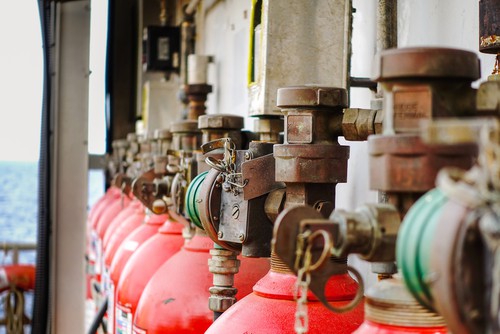
A fire extinguisher needs to be recharged any time it’s been used — even partially — or when a professional inspection reveals it’s lost pressure. Recharging restores the agent and pressure to factory specifications, so the unit is ready to perform when it’s actually needed.
In New York, the cost to recharge a fire extinguisher ranges from $20 to $80 per unit, depending on the size and type. A standard ABC dry chemical unit runs toward the lower end. CO2 extinguishers and larger commercial units cost more, both because of the agent cost and the equipment required. Wet chemical Class K extinguishers — common in restaurant kitchens — also carry higher recharge costs given the specialized agent involved.
Is It Cheaper to Recharge or Replace a Fire Extinguisher?
This is one of the most common questions we hear, and the honest answer is: recharging is almost always the better value — typically 50 to 75 percent cheaper than buying a new unit — as long as the extinguisher itself is in good condition. If the cylinder passes its hydrostatic test, the valve is functioning properly, and there’s no structural damage, recharging makes financial sense.
The calculus changes when the unit is old, has failed hydrostatic testing, or has been physically damaged. At that point, replacement is the right call — not because it’s the more profitable recommendation, but because a compromised cylinder isn’t worth putting back into service.
One thing to watch for in New York specifically: some businesses assume they can just pick up a new extinguisher from a hardware store and skip the service call. That works in some states. In NYC, it doesn’t — not fully. Any extinguisher in the five boroughs still needs an FDNY-compliant tag from an approved provider before it’s considered properly inspected under the city’s fire code. Buying a new unit from a retail shelf and hanging it on the wall doesn’t satisfy that requirement on its own. You still need a certified technician to inspect it and attach the proper documentation.
For Long Island businesses, the retail replacement route is more straightforward — NFPA 10 compliance doesn’t carry the same FDNY tag requirement outside the five boroughs — but professional inspection is still required annually, and documentation still needs to be maintained for at least three years. Cutting corners on paperwork is one of the more common ways businesses end up with violations even when their equipment is technically functional.
If you’re weighing recharge versus replace and you’re not sure which way to go, the simplest approach is to have a technician assess the unit during a service call. The inspection will tell you what you’re actually working with.
What Happens If You Skip Service — FDNY Fines and What They Actually Cost
It’s worth putting the cost of fire extinguisher service in context, because the math changes significantly when you factor in what non-compliance costs in New York.
FDNY issued more than 22,000 violations across New York City in 2024 alone. Fire extinguisher violations — missing units, expired inspections, defective equipment — fall under FDNY violation code VC7. The fine range for these violations runs from $800 to $5,000 or more per violation. And that’s before you account for the administrative burden: once you receive an FDNY summons, you have 35 days to correct the issue and file a Certificate of Correction. Miss that window and you’re looking at a hearing. Let an ECB fine go unpaid past 60 days and it converts to a property lien.
For a business owner running a restaurant, or a property manager overseeing a mixed-use building, or a retail operator with locations across Nassau County — the annual cost of staying current on fire extinguisher service is a fraction of a single violation. A $40 to $100 inspection doesn’t feel like a significant expense when the alternative is an $800 fine on the low end and a compliance scramble on a 35-day clock.
There’s also the insurance angle. Commercial property insurers in New York routinely require documented annual inspections as a condition of coverage. If you’re heading into a renewal and you don’t have records going back at least three years, you may find yourself in a difficult conversation with your broker. The documentation requirement isn’t just a regulatory formality — it’s proof that your equipment is maintained and your risk profile is what you say it is.
The businesses that tend to get caught are the ones that assume FDNY inspections are scheduled in advance. They’re not. FDNY inspectors show up unannounced. By the time you receive a violation notice, the problem already exists — the only question is how quickly you can resolve it.
Getting Fire Extinguisher Service Right in New York Without Overpaying
Fire extinguisher service in New York doesn’t have to be a mystery. Annual inspections run $40 to $100 per visit for most businesses. Recharging costs $20 to $80 per unit. The 6-year internal maintenance runs $40 to $80 per unit, and hydrostatic testing falls in a similar range. Those are the real numbers for this market — and now you have them before you’ve called anyone.
What matters beyond price is making sure the company you hire is actually authorized to do the work. In NYC, that means an FDNY Certificate of Approval and technicians who can provide genuine FDNY-issued standardized tags. On Long Island, it means certified technicians who know NFPA 10 and will give you the documentation you need for insurance and compliance purposes.
M&M Fire Extinguishers Sales & Services, Inc. has been doing this work across Long Island and all five boroughs of New York City since 1990. We offer free on-site estimates — no pressure, no surprises on the invoice. Reach out and we’ll take it from there.
Related posts