

FDNY Fire Code, NFPA 10, and OSHA: Which Rules Actually Apply to Your Nassau County Business?
August 14, 2026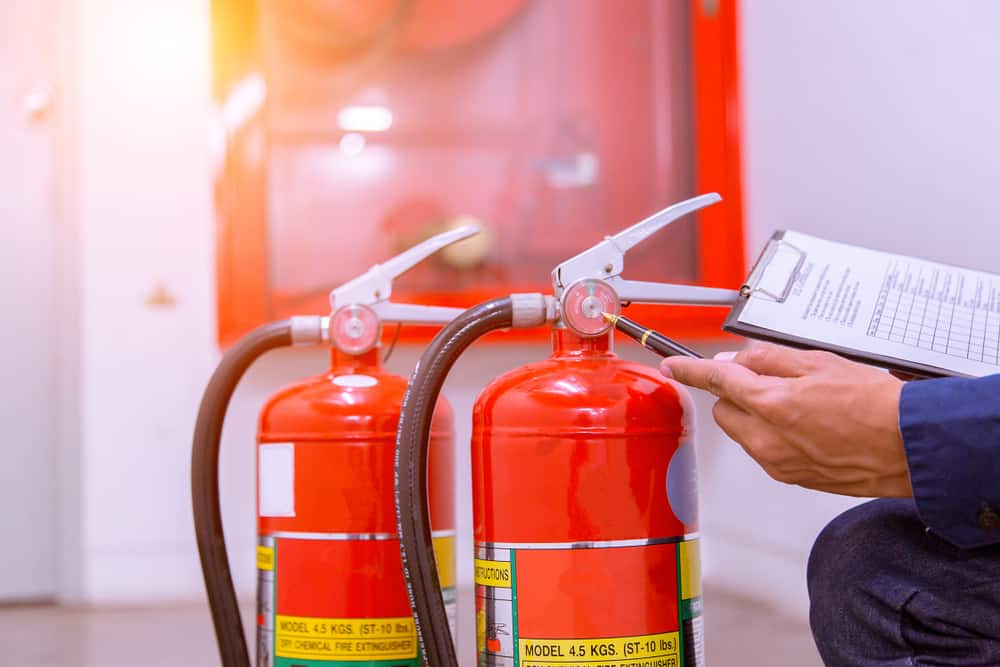
Commercial Fire Protection for Long Island Warehouses and Industrial Sites
August 20, 2026
Summary:
Most Nassau County business owners assume fire extinguisher service means scheduling someone to come in once a year, check the gauge, and slap a new tag on it. That’s part of it. But it’s a long way from the whole picture.
The full scope of fire extinguisher service runs from the day you first hang a unit on the wall to the day it gets condemned and needs to be properly disposed of. In between, there are inspection intervals, maintenance requirements, recharging protocols, and testing cycles — each with its own rules, its own timeline, and its own consequences if you skip it.
Here’s what you’re actually signing up for, and why it matters more than most people think.
Fire Extinguisher Maintenance: What NFPA 10 Actually Requires
NFPA 10 is the national standard that governs how portable fire extinguishers are selected, placed, inspected, and maintained. It doesn’t just require an annual visit — it lays out four distinct service tiers that apply over a 12-year cycle.
The first tier is a monthly visual check. This one can be done by your own staff — you’re verifying the unit is in its designated spot, the pressure gauge reads in the green, the pull pin and tamper seal are intact, and there’s no visible damage. Simple, but it has to happen every single month, and at least 12 consecutive monthly records need to be on file.
The second tier is the annual maintenance examination. This is where a certified technician has to be involved. They’re not just glancing at the gauge — they’re examining the mechanical parts, the extinguishing agent, the expelling mechanism, and the overall condition of the unit. They install a new tamper seal and document the service with a signed, dated inspection tag. That tag is what a Nassau County Fire Marshal or FDNY inspector is going to look for. Regular fire extinguisher maintenance helps businesses keep these required service intervals and records on track.
What Happens at the 6-Year and 12-Year Service Intervals?
This is the part most business owners don’t know about — and it’s exactly where compliance gaps tend to show up.
At the six-year mark, NFPA 10 requires an internal examination. The extinguisher gets depressurized and opened so a technician can inspect the inside for corrosion, degradation, or any other damage that wouldn’t be visible from the outside. Annual inspections check the exterior and function. The six-year exam checks what’s happening inside the cylinder. If you’ve been getting annual inspections but nobody has mentioned a six-year internal exam, that’s a gap worth addressing.
At the twelve-year mark, the cylinder itself has to undergo hydrostatic pressure testing. The unit is filled with water and pressurized to test the structural integrity of the cylinder. If it fails, the extinguisher is condemned. If it passes, it can continue to be used. For smaller units — a 5 lb or 10 lb ABC dry chemical extinguisher, for example — replacement is often more cost-effective than testing at that point. A certified technician can walk you through the math.
What makes this important for Nassau County businesses specifically is that these longer-interval requirements don’t come up in casual conversation. A lot of building owners in Hempstead, NY; Hicksville, NY; or Massapequa, NY are getting their annual inspection done and genuinely believe they’re covered. They are — until the fire marshal asks about the six-year internal exam and the paperwork isn’t there.
The Nassau County Fire Marshal’s Office conducts regular commercial property inspections, and violations for missing documentation can carry fines up to $5,000 per offense. That’s not a number to be casual about. The four-tier service schedule isn’t optional based on the size of your business or how often you use the space. It applies to every portable fire extinguisher in every commercial property, regardless of whether the unit has ever been touched.
Does Your Fire Extinguisher Service Company Need to Be Licensed in Nassau County?
Yes — and this is one of the most common compliance mistakes Nassau County businesses make.
A fire extinguisher service company licensed to operate in New York City under an FDNY Company Certificate is not automatically authorized to service extinguishers in Nassau County. The two jurisdictions have separate licensing requirements. Nassau County operates under the Nassau County Fire Commission, which sets its own standards and enforces them independently of the FDNY. If your current service provider holds only an NYC license, and they’re servicing your Freeport, NY restaurant or your Garden City, NY office building, you may not be in compliance — even if the inspection tags look current.
This matters for a few reasons. First, the obvious one: if the Nassau County Fire Marshal inspects your property and finds that your extinguishers were serviced by a company not authorized to operate in the county, the inspection tags don’t count. You’re looking at a violation as if no service had been done at all. Second, it creates a real problem with your insurance. If you ever need to file a claim and it comes out that your fire safety equipment wasn’t properly serviced by a licensed provider, your coverage could be at risk.
The FDNY updates its approved company list every 30 days, so it’s easy enough to verify whether a company is authorized for NYC work. Nassau County credentials are a separate verification. Before you sign any service contract, it’s worth confirming that the provider is actually licensed to work in Nassau County — not just in the boroughs.
We hold credentials for both markets. That matters because a lot of our clients operate across Nassau County and the five boroughs, and they need a single provider who can handle compliance on both sides of that line without the business owner having to manage two separate vendor relationships.
Fire Extinguisher Recharge: When It's Required and What It Involves
Recharging is one of those services that sounds straightforward until you realize how many situations actually trigger it. The most obvious one is after any use — even if the extinguisher was only partially discharged, NFPA 10 requires a full recharge before the unit goes back into service. But that’s not the only trigger.
Recharging is also required when an annual maintenance inspection reveals that the pressure is low, the agent has degraded, or the unit otherwise doesn’t meet the standards for full readiness. It’s part of the six-year internal examination process as well, since the extinguisher has to be depressurized and emptied before the internal inspection can happen.
The process itself involves more than just topping off the pressure. A technician depressurizes the cylinder, removes the contents, evaluates the interior and exterior, checks the valves, reassembles the unit, refills it with the appropriate extinguishing agent, repressurizes it to the correct charge, runs a leak test, and completes the service documentation. For a single unit, the hands-on portion takes roughly 15 to 30 minutes when done properly.

Fire Extinguisher Refill vs. Recharge: What's the Difference?
The terms get used interchangeably, and in most practical conversations they refer to the same service — restoring the extinguisher to full operational readiness by replenishing both the extinguishing agent and the pressure charge. When a technician talks about recharging your extinguisher, they mean the complete process: agent, pressure, inspection, and documentation.
“Refill” sometimes refers specifically to replacing the extinguishing agent alone, without the full evaluation process. In practice, a reputable service company won’t just refill the agent and send you on your way — we’ll go through the full recharge procedure because the agent and the pressure system need to be evaluated together for the unit to be considered ready.
There’s one important distinction that does matter here: not every fire extinguisher can be recharged. Units with plastic valves, typically labeled “non-rechargeable” or “disposable,” cannot be safely refilled once they’ve been used or have lost pressure. They have to be replaced. Commercial-grade extinguishers — the kind you’ll find in most Nassau County restaurants, office buildings, warehouses, and retail spaces — are almost always rechargeable metal-cylinder units. For those, recharging is almost always more cost-effective than replacement, especially for larger units.
If you’re not sure whether your extinguisher is rechargeable, the easiest way to find out is to have a certified technician take a look. Trying to recharge a non-rechargeable unit is a safety hazard, and replacing a perfectly good rechargeable unit is an unnecessary expense. A quick evaluation during an annual service visit answers the question definitively.
How to Dispose of a Fire Extinguisher in New York — The Right Way
This is the part of fire extinguisher service that almost nobody talks about, and it causes a surprising amount of confusion for Nassau County business owners who are replacing old or condemned units.
Fire extinguishers cannot go in the regular trash. They’re pressurized vessels containing chemical agents, and improper disposal is both illegal and genuinely hazardous. In New York State, the rules depend on the type of extinguisher. Dry chemical and CO2 units can be recycled with bulk metal — but only after they’ve been properly depressurized, the agent has been removed, and the head has been taken off. That process has to be done by a certified technician. You can’t just crack the valve in the parking lot and call it done.
Class K extinguishers — the wet chemical units used in commercial kitchens, which are common throughout Nassau County’s restaurant and food service industry — require special handling because of the nature of the suppression agent. Halon extinguishers, which are less common now but still found in older buildings, require hazardous waste disposal procedures.
For most Nassau County businesses, the practical answer is to work with a full-service fire protection company that handles disposal as part of the replacement process. When we condemn a unit during a service visit, we don’t leave you holding an old extinguisher and a set of instructions. We handle it. That’s what full-service actually means — you don’t have to figure out the disposal logistics on top of everything else you’re managing.
If you have old units sitting in a storage room because you weren’t sure what to do with them, that’s a very common situation. It’s also an easy one to resolve. A service call that includes disposal assessment takes care of it in one visit.
Fire Extinguisher Service in Nassau County: What to Do Next
Fire extinguisher service isn’t a single event — it’s a lifecycle. Monthly visual checks, annual maintenance by a certified technician, a six-year internal examination, a twelve-year hydrostatic test, recharging when needed, and proper disposal at the end of the unit’s life. Each stage has real requirements, and missing any one of them creates a compliance gap that the Nassau County Fire Marshal’s Office will find before you do.
The good news is that none of this has to be complicated when you’re working with the right provider. A company that’s licensed for Nassau County, carries the right certifications, and handles the full scope of service means you’re not managing multiple vendors or piecing together who’s responsible for what.
If you’re not sure where your extinguishers stand — whether the service history is current, whether your provider is actually licensed in Nassau County, or whether any units are due for internal examination or hydrostatic testing — the right move is a straightforward on-site evaluation. M&M Fire Extinguishers Sales & Services, Inc. has been doing this work across Nassau County and the greater New York metro for over 35 years. Reach out and we’ll tell you exactly where things stand.
Related posts