5 Signs Your Extinguisher Inspection May Not Hold Up in Nassau County
August 14, 2026
What Fire Extinguisher Service Actually Covers in Nassau County
August 18, 2026
Summary:
If you run a business in Nassau County, NY and you’ve been trying to figure out your fire extinguisher obligations, there’s a good chance you’ve landed on FDNY fire code information and assumed it applied to you. That’s a completely understandable mistake — the FDNY is the dominant name in fire safety across the entire New York metro area. But here’s the thing: FDNY jurisdiction ends at the city line. Nassau County operates under a completely different set of rules, enforced by a completely different authority. On top of that, there’s a federal standard — OSHA — that applies to your business regardless of where you’re located. Let’s sort all of this out.
FDNY Fire Code Doesn't Apply in Nassau County — Here's What Does
The FDNY fire code governs fire safety within New York City’s five boroughs: Manhattan, Brooklyn, Queens, the Bronx, and Staten Island. If your business is located in Nassau County, NY — even just over the Queens border — FDNY fire code does not apply to you.
Your governing authority is the Nassau County Fire Commission, which enforces the Nassau County Fire Prevention Ordinance through the Nassau County Fire Marshal’s Office. This distinction matters more than most people realize. A fire extinguisher company that’s licensed and approved to work in NYC is not automatically licensed to operate in Nassau County, NY. These are separate licensing systems, and the credentials don’t transfer.
If you’re in Nassau County and you hire a company based on their FDNY credentials alone, you may end up with an inspection that doesn’t satisfy your actual enforcement authority. That’s why we make sure our Nassau County clients know exactly who’s inspecting their equipment and whether that company is properly licensed in their jurisdiction.
How Nassau County Fire Code Enforcement Actually Works
Nassau County takes a centralized approach to fire code enforcement. Unlike Suffolk County, which operates through 109 separate fire districts with varying levels of consistency, Nassau County runs all commercial fire safety enforcement through a single county-level structure. That means the standards are applied uniformly across Nassau County — whether your business is on Hempstead Turnpike, along Sunrise Highway, or in one of the industrial corridors around Deer Park and Hicksville.
The Nassau County Fire Marshal conducts regular inspections of commercial properties, and when violations are found, they’re treated seriously. Fines can reach up to $5,000 per offense, and each violation is counted separately. If you have three non-compliant fire extinguishers, that’s potentially three separate fines.
The Fire Marshal also has the authority to order immediate remediation — and in serious cases, to force a business to close until violations are corrected. The Nassau County Fire Prevention Ordinance references NFPA standards, which brings us to the second layer of the compliance picture. Nassau County fire code doesn’t exist in isolation — it draws from the same national standards framework that governs fire safety across the country. So while FDNY fire code doesn’t apply to your Nassau County location, the underlying NFPA standards very much do, just enforced locally rather than through the FDNY.
One more thing worth knowing: the FDNY’s numbered tag program — which requires NYC businesses to have FDNY-issued inspection tags as proof of compliance — is specific to New York City. In Nassau County, NY, the documentation requirements are different, but the principle is the same. Your inspection needs to come from a company that’s properly licensed in your jurisdiction and capable of producing documentation that satisfies the Nassau County Fire Marshal.
What Is NFPA 10 and Does It Apply to Nassau County Businesses?
NFPA 10 is the national standard for portable fire extinguishers — it covers everything from which type of extinguisher belongs in which environment, to how far away any point in a building can be from the nearest unit, to how often inspections and maintenance need to happen. It’s published by the National Fire Protection Association and adopted by reference in both New York City’s fire code and New York State’s Uniform Fire Prevention and Building Code, which Nassau County falls under.
What that means in practice is that NFPA 10 isn’t optional guidance — it carries the force of law in Nassau County, NY. The specific requirements include a monthly visual inspection (which is the building owner’s or employer’s responsibility, not the service company’s), an annual professional maintenance visit performed by a certified technician, a 6-year internal examination, and a 12-year hydrostatic test. Skipping any of these isn’t just a best practice gap — it’s a code violation.
On placement, NFPA 10 requires that every point in a building be within 75 feet of a properly rated Class A extinguisher. For Class B hazards — flammable liquids, for example — that distance tightens to 30 to 50 feet depending on the hazard level. If you run a restaurant in Nassau County, you also need a Class K extinguisher within 30 feet of all commercial cooking equipment, full stop. These aren’t suggestions; they’re measurable requirements that fire marshals check during inspections.
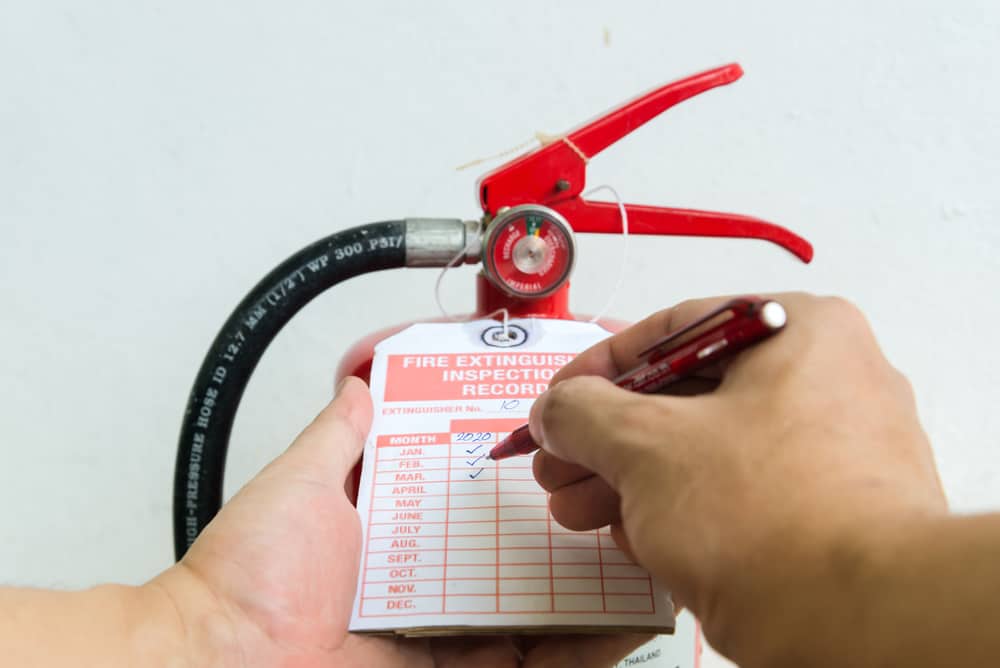
One thing that surprises a lot of business owners: the monthly visual inspection is on you, not your service provider. NFPA 10 requires the building owner or employer to check each extinguisher every month — confirming it’s in its designated location, the gauge reads in the green, the pin is intact, and there’s no visible damage. You don’t need a certification to do it, but you do need to document it. That documentation can be the difference between passing and failing a Nassau County Fire Marshal inspection.
OSHA Fire Extinguisher Requirements: The Federal Layer Nassau County Businesses Often Miss
Here’s where a lot of Nassau County, NY businesses have a compliance blind spot. OSHA 29 CFR 1910.157 is a federal standard that applies to all general industry workplaces with employees — regardless of state or local fire code. It doesn’t matter whether you’re in Nassau County or anywhere else in the country. If you have employees, OSHA applies to you.
The reason this matters is that many business owners assume local fire code compliance covers everything. It doesn’t. OSHA and Nassau County fire code exist as separate, simultaneous obligations. You can be fully compliant with the Nassau County Fire Marshal’s requirements and still be in violation of OSHA — and vice versa. Both have to be satisfied at the same time.
How OSHA and NFPA 10 Work Together — and Why One Doesn't Replace the Other
OSHA 1910.157(b)(1) explicitly incorporates NFPA 10 by reference. That means meeting NFPA 10 is a component of OSHA compliance — not a separate track you can choose instead. If you’re following NFPA 10 properly, you’re covering a significant portion of your OSHA obligations at the same time. But OSHA also adds its own specific requirements on top of that.
Mounting height is one example. OSHA requires that fire extinguishers weighing under 40 pounds be mounted with the handle no higher than five feet from the floor. Units over 40 pounds drop to three and a half feet. These are specific, measurable requirements that OSHA inspectors check independently of what the fire marshal looks at. A unit that’s physically present and properly tagged for fire code purposes can still generate an OSHA citation if it’s mounted at the wrong height.
The penalty structure under OSHA is also worth understanding. As of 2026, a serious OSHA violation carries a fine of up to $16,131. A willful violation — where the employer knew about the hazard and chose not to address it — can reach $161,323. These are federal penalties that stack on top of any Nassau County fines, meaning a business with multiple compliance gaps is looking at exposure from two directions simultaneously.
The “more stringent standard governs” principle applies when OSHA and local code conflict — whichever requirement is more protective is the one you have to meet. For most Nassau County businesses, the practical takeaway is straightforward: get your fire extinguishers inspected and maintained by a certified technician annually, document your monthly visual checks, make sure your units are properly mounted and positioned, and work with a company that understands both the Nassau County requirements and the OSHA overlay. Treating these as separate checklists you can address one at a time is how compliance gaps develop.
What a Fire Safety Inspection Actually Checks in Nassau County
When the Nassau County Fire Marshal shows up at your commercial property, they’re not doing a casual walk-through. They’re checking specific, documented requirements — and the results can trigger fines, remediation orders, or in serious cases, a closure order.
On the fire extinguisher side, inspectors look at whether you have the right types of extinguishers for the hazards present in your space. A restaurant along Hempstead Turnpike needs Class K coverage for the commercial kitchen in addition to standard ABC units for the dining and storage areas. A warehouse in Hicksville with flammable materials needs Class B coverage at appropriate distances. Having the wrong type of extinguisher for a given area is a violation, even if the unit is fully charged and properly tagged.
They also check placement and travel distance. Every point in your facility needs to be within the code-required distance of an appropriate extinguisher. A unit that’s been moved to a back room for convenience, or blocked by a storage rack, or tucked behind a door that’s usually open — all of those create violations. The extinguisher needs to be visible, accessible, and in its designated location.
Documentation is another major focus. Your annual inspection needs to have been performed by a certified technician from a company properly licensed in Nassau County, and the resulting service record needs to be current and on-site. Your monthly visual inspection records need to exist. If a fire marshal asks for documentation and you can’t produce it, the absence of records is itself a violation — separate from whatever the physical condition of the equipment might be.
Beyond extinguishers, fire safety inspections in Nassau County also cover exit lighting, emergency signage, and in some occupancies, fire suppression systems. Restaurants with commercial kitchen exhaust systems face additional suppression system maintenance requirements. If any of these are out of compliance during the same inspection, each item is a separate violation — and the fines add up quickly.
Getting Fire Code Compliance Right in Nassau County, NY
The short version of everything above: Nassau County, NY businesses are not governed by FDNY fire code. Your rules come from the Nassau County Fire Prevention Ordinance, NFPA 10 (adopted by reference under New York State law), and OSHA 1910.157 — all three, simultaneously. Understanding where each one applies, and where they overlap, is the difference between genuine compliance and a false sense of security.
The most common mistake isn’t ignoring fire safety entirely — it’s assuming that one layer of compliance covers the others. It doesn’t. A properly tagged extinguisher from a company not licensed in Nassau County still leaves you exposed. A Nassau County-compliant setup that doesn’t meet OSHA mounting requirements still generates federal liability. These gaps are easy to miss and expensive to discover during an inspection.
If you’re not sure where your business currently stands — whether you’re opening a new location, getting ready for a fire marshal visit, or just trying to make sure everything is actually in order — we’ve been handling exactly this kind of compliance work across Nassau County and the five boroughs for over 35 years. Call us and we’ll come out and take a look.
Related posts