Is Your Commercial Kitchen Fire Suppression System Fall-Ready? A Nassau County Guide
September 25, 2026
FDNY Violation Fines vs. Inspection Costs: Real Dollar Comparison for Nassau County
October 2, 2026
Summary:
If you run a business in Nassau County, fire safety compliance probably isn’t the first thing on your mind every morning. But it should be somewhere on the list — because the Nassau County Fire Commission isn’t waiting for you to get around to it, and neither is your insurance carrier. Annual fire extinguisher inspections are legally required. Kitchen suppression systems have their own set of standards. And the rules here are not the same as they are across the border in New York City. This guide is built for business owners who want straight answers about what fire protection service actually requires — and where to go to get it done right.
What Fire Protection Service Actually Covers in Nassau County
A lot of business owners think fire protection means having a red extinguisher mounted near the back door. That’s a start, but it’s nowhere close to the full picture. Fire protection service covers the inspection, maintenance, and documentation of every fire safety system in your building — extinguishers, suppression systems, sprinklers, exit lighting, and emergency signage. Each of those components has its own compliance schedule, its own standard, and its own paper trail that regulators and insurers will ask to see.
In Nassau County specifically, compliance is centralized through the Nassau County Fire Commission under the Nassau County Fire Prevention Ordinance, which was most recently amended in April 2024. That means enforcement is consistent across the county — whether your business is in Mineola, Hicksville, or Great Neck, the same rules apply. Assuming otherwise is one of the most common and costly mistakes business owners make.
What Does an Annual Fire Extinguisher Inspection Actually Involve?
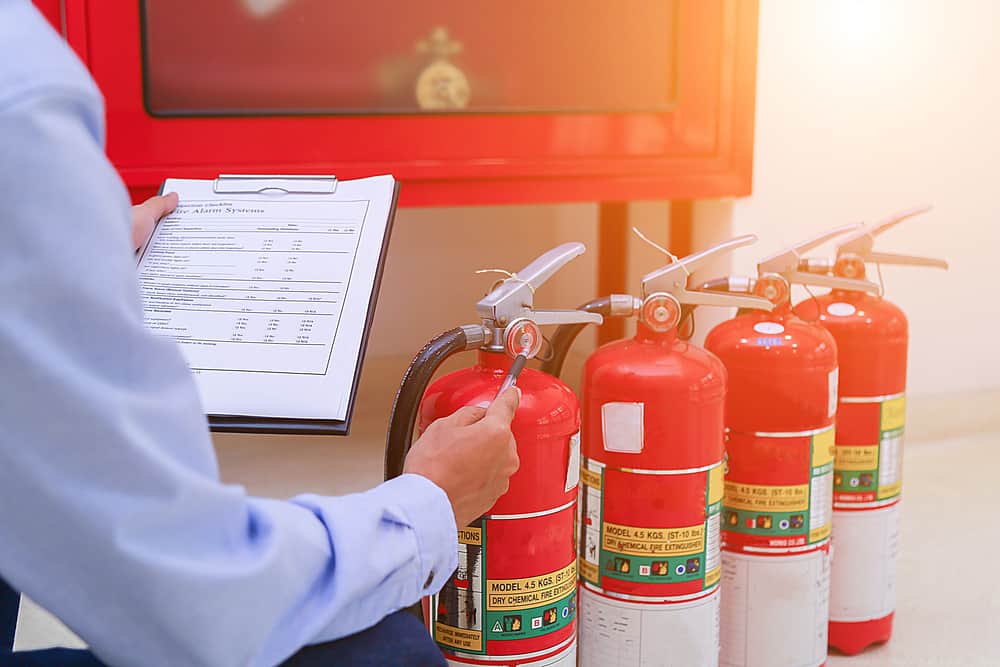
The annual inspection requirement comes from two places: OSHA’s standard 29 CFR 1910.157 and NFPA 10, which is the technical standard most local fire codes — including Nassau County’s — are built on. Under those rules, a certified technician needs to physically examine each extinguisher, verify it’s properly mounted and accessible, check the pressure gauge and physical condition, confirm the correct type is in place for the hazards present, and document everything with a signed inspection tag and service record.
What it is not is a quick glance and a sticker. That’s the version some cut-rate operators deliver, and it’s also the version that gets business owners in trouble when a Fire Marshal shows up or when an insurance claim gets denied because documentation is missing or invalid.
Beyond the annual visit, NFPA 10 also requires a six-year internal inspection for stored-pressure extinguishers — where the unit is fully disassembled and examined — and hydrostatic pressure testing every twelve years. Most business owners have never heard of either of those requirements, which is exactly why violations happen. The annual inspection is the baseline, not the ceiling.
For businesses with multiple extinguishers across a large footprint — a warehouse in Hicksville, a retail strip in Hempstead, a restaurant in Woodbury — the documentation burden adds up quickly. We track all of it, schedule the work, and keep your records organized so you’re not scrambling when an inspection or renewal comes due.
One more thing worth knowing: your employees may be doing monthly visual checks as required by OSHA, and that’s their job to handle. But the annual professional maintenance is a separate, legally required service that cannot be self-performed. It has to be done by a certified company. Checking the gauge yourself every month does not substitute for that.
Nassau County Fire Code vs. NYC Rules — Why the Difference Matters
This is where a lot of Nassau County business owners run into real trouble, especially those who also manage properties or locations in New York City. Nassau County operates under its own Fire Prevention Ordinance, enforced by the Nassau County Fire Commission and its Fire Marshals. New York City operates under FDNY authority. The two systems have different requirements, different inspection processes, and critically — different licensing requirements for the companies doing the work.
A fire protection company that holds an FDNY Certificate of Fitness is licensed to perform fire protection work in New York City. That credential does not automatically extend to Nassau County. The reverse is also true. If you’ve been using a NYC-focused fire protection company to service your Nassau County locations, there’s a real chance the work isn’t being performed under the correct local authority — which means your compliance documentation may not hold up when it matters most.
This isn’t a technicality. The Nassau County Fire Commission enforces its ordinance independently of the FDNY, and citations issued under the NCFPO carry their own penalties and remediation requirements. Getting a violation notice is stressful enough. Getting one because your service provider wasn’t properly credentialed for Nassau County work is entirely avoidable.
For business owners with locations in both jurisdictions, the practical solution is working with a fire protection company that holds credentials for both. It eliminates the gap, simplifies your vendor management, and ensures that every location — whether it’s in Garden City or in one of the five boroughs — is being serviced by someone who’s actually authorized to do it. That dual-jurisdiction capability is relatively rare, and it’s worth asking about directly before you sign any service agreement.
Fire Protection System Requirements by Business Type
Not every business has the same fire protection requirements, and the differences matter more than most people realize. A standard office in Mineola has different needs than a commercial kitchen in Great Neck or a warehouse operation near the Nassau-Suffolk border. The type of hazards present, the square footage, the occupancy classification, and the nature of the business all factor into what systems are required and how they need to be maintained.
Understanding your specific obligations — rather than assuming the basics are enough — is what separates businesses that pass inspections from businesses that don’t. The organizations and standards listed below are the starting point for getting that clarity.

Key Organizations and Standards Every Nassau County Business Owner Should Know
The Nassau County Fire Commission is the first place to start. It’s the central enforcement body for fire code compliance across the county, and its Fire Marshals are the ones conducting inspections and issuing citations. Their contact information is publicly available through the Nassau County government website, and reaching out directly when you have compliance questions is always a reasonable first step.
The National Fire Protection Association — NFPA — publishes the technical standards that most fire codes in New York are built on. NFPA 10 governs portable fire extinguishers. NFPA 96 governs commercial kitchen ventilation and suppression systems. NFPA 25 covers water-based systems like sprinklers. NFPA 72 covers fire alarm systems. These aren’t light reading, but knowing which standard applies to your business type helps you ask better questions when you’re evaluating a service provider.
OSHA’s standards are also directly relevant for any employer. The federal requirement under 29 CFR 1910.157 mandates monthly visual inspections by staff, annual professional maintenance by a certified company, and training for any employee designated to use an extinguisher. OSHA’s New York Area Office and the NYS Department of Labor both publish guidance on workplace fire safety compliance that’s worth reviewing if you have employees on site.
For restaurant owners in Nassau County specifically, the Nassau County Department of Health has requirements touching on commercial kitchen safety. The National Restaurant Association also publishes fire safety resources tailored to food service operators — covering everything from hood cleaning schedules to suppression system testing intervals. Commercial kitchens are required to have UL300-compliant wet chemical suppression systems, and those systems require their own inspection and maintenance schedule separate from your portable extinguishers.
The Nassau County Office of Economic Development and the Long Island Small Business Development Center are also worth knowing. Neither is a fire safety organization, but both offer resources for small business owners navigating compliance requirements more broadly — and connecting with a local SBDC advisor can help you understand what obligations apply to your specific business type and location.
How to Evaluate a Fire Protection Service Provider in Nassau County
Once you know what you need, the next question is who you trust to deliver it. In Nassau County, the baseline is straightforward: the company needs to be properly credentialed to perform work in this jurisdiction. That means asking directly about their Nassau County licensing and their FDNY Certificate of Fitness if they also service NYC properties. A legitimate provider will have no hesitation answering that question.
Beyond credentials, look for a company that provides written documentation after every service visit — inspection tags on each extinguisher, service records you can file, and a clear schedule for any upcoming maintenance milestones. That paper trail is what protects you if a Fire Marshal visits or if your insurance carrier asks for proof of compliance. Verbal assurances are worth nothing in those conversations.
Full-service coverage matters more than most business owners expect. A company that only handles portable extinguishers leaves you managing a separate vendor relationship for your suppression system, a different one for your exit lighting, and another for your fire alarm. That fragmented approach creates gaps — in scheduling, in documentation, and in accountability when something goes wrong. A single provider who covers the full scope of your fire protection system is a meaningfully better arrangement.
Response time is also a real factor. FDNY violation notices and Nassau County Fire Marshal citations don’t come with generous deadlines. If your service provider can’t respond same-day or after hours, you’re carrying a risk that compounds quickly. Ask about emergency availability before you need it, not after.
Finally, pay attention to how a company talks about pricing. The fire protection industry has a history of opaque billing — post-service charges that weren’t discussed upfront, fees that appear after the technician leaves. A company that offers a free on-site estimate and gives you clear pricing before any work begins is operating with a level of transparency that’s worth something. It’s a simple signal, but it’s a reliable one.
Getting Fire Protection Service Right in Nassau County
Fire protection compliance in Nassau County isn’t complicated once you understand what’s actually required — but getting there means knowing the right standards, the right organizations, and the right questions to ask. The Nassau County Fire Prevention Ordinance, NFPA 10, OSHA’s workplace standards, and the specific requirements for your business type all play a role. Ignoring any one of them is where violations happen.
The good news is that most of this is manageable with the right service provider in your corner. Annual inspections, suppression system maintenance, documentation, dual-jurisdiction coverage — we handle all of it so you’re not piecing it together yourself.
If you’re a Nassau County business owner who wants to get compliant, stay compliant, and stop guessing at whether your fire protection is actually up to code, M&M Fire Extinguishers Sales & Services, Inc. has been doing this work across Long Island and the five boroughs for more than 35 years. Reach out and ask for a free on-site estimate — it’s a straightforward conversation, and it starts with understanding exactly what your business needs.
Related posts