Commercial Fire Protection for Long Island Warehouses and Industrial Sites
August 20, 2026
Fire Extinguisher Inspection Cost in Nassau County, NY: 2026 Pricing
August 21, 2026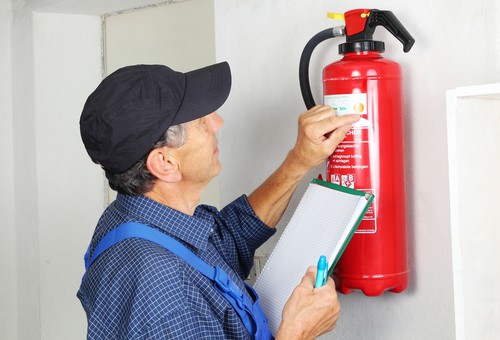
Summary:
Fire safety compliance on Long Island is more complicated than most business owners realize. Between the Nassau County Fire Marshal, the Suffolk County Fire Marshal, and the FDNY’s separate jurisdiction over the five boroughs, knowing which rules apply to your business — and where to turn for help — takes real local knowledge.
This resource roundup cuts through the confusion. We’ve pulled together the agencies, regulatory bodies, and official tools that Long Island and New York City business owners should have bookmarked before their next inspection — or their first violation notice. Understanding fire safety compliance requirements can help businesses navigate inspections and respond to violations more effectively.
If you run a business on Long Island, fire safety compliance probably isn’t your favorite topic. It’s not glamorous, it’s not simple, and the rules are harder to track down than they should be. Most business owners don’t find out they’ve been doing something wrong until a violation notice shows up — and by then, the clock is already ticking.
This page exists to change that. We’ve put together a practical, locally focused list of the fire safety agencies, regulatory offices, and official resources that every Nassau County, Suffolk County, and NYC-area business owner should know about. Bookmark it. Share it with your office manager. Come back to it before your next renewal.
Fire Protection Equipment Rules on Long Island: Why It's More Complicated Than You Think
Here’s something a lot of Long Island business owners don’t know: Long Island and New York City operate under two completely different fire codes. If your business is in Nassau or Suffolk County, you fall under the New York State Fire Code. If you also have a location in Queens or Brooklyn, that location is governed by the NYC Fire Code — a separate legal framework administered by the FDNY Bureau of Fire Prevention.
Same region, different rulebook. This isn’t a technicality. It affects which certifications your fire equipment service company needs to hold, which inspections are required and how often, and who has the authority to issue violations against your business. Getting it wrong — even accidentally — can mean fines ranging from $300 to $1,000 per extinguisher, depending on the severity of the violation. Understanding local fire code compliance requirements can help businesses avoid costly violations.
How to Find a Legitimate Fire Safety Supplier in New York
The FDNY has documented a real pattern of fraudulent fire extinguisher service companies operating in the New York area — companies that show up, slap a tag on your extinguisher, and hand you paperwork that won’t hold up to an actual inspection. It happens more than people realize, and the business owner is the one left holding the violation.
So how do you verify that a fire safety supplier is actually authorized to work in your area? If you also have a location in New York City, start with the FDNY Approved Companies List. This is a publicly available document — you can access it through the FDNY’s official website at nyc.gov/fdny — and it confirms which companies hold valid Certificates of Fitness, carry the required minimum insurance of $500,000 in liability coverage, and meet manufacturer certification standards. If a company servicing your extinguishers in any of the five boroughs isn’t on that list, the service isn’t legal.
For Nassau County, the rules go a step further. Any technician who physically touches a fire extinguisher for service in Nassau County must hold a valid Certificate of Fitness issued specifically by the Nassau County Fire Marshal’s Office. This is separate from FDNY certification. Nassau County publishes a list of licensed portable fire extinguisher service contractors through their document center at nassaucountyny.gov — it’s worth pulling up before you hire anyone.
The Fire Marshal’s Office itself is located at 1194 Prospect Avenue in Westbury, reachable at (516) 573-9900, with a front desk window open from 9 AM to noon if you need to walk in.
Suffolk County operates differently. Rather than a single centralized authority, Suffolk has 109 volunteer fire departments functioning under different local codes. That decentralized structure creates real complexity for business owners — especially those with multiple locations across the county.
The Suffolk County Fire Marshal’s Office falls under the Department of Fire, Rescue, and Emergency Services, and their resources are available through suffolkcountyny.gov. If you’re unsure which local authority governs your specific address in Suffolk, that office is the right starting point.
What Each Regulatory Agency Actually Does — and Why It Matters for Your Business
Understanding who does what saves you a lot of confusion when compliance questions come up. Here’s a plain-language breakdown of the agencies Long Island business owners interact with most.
The FDNY Bureau of Fire Prevention is the governing body for fire code compliance in all five NYC boroughs. If your business is in Queens, Brooklyn, Manhattan, Staten Island, or the Bronx, this is the office that issues violations, approves service companies, and conducts routine inspections.
Commercial buildings in NYC are typically inspected annually or biannually; places of assembly — restaurants with seating over 75, theaters, nightclubs — receive quarterly inspections. The FDNY’s business compliance resources are available at nyc-business.nyc.gov.
The Nassau County Fire Marshal’s Office handles fire prevention enforcement across Nassau County, with a more centralized structure than what you’ll find in Suffolk. They maintain the licensed contractor list, issue Certificates of Fitness to qualified technicians, and oversee code compliance education for local businesses. If you’re in Garden City, Great Neck, Mineola, Rockville Centre, or anywhere else in Nassau, this is the office that has authority over your fire safety equipment requirements.
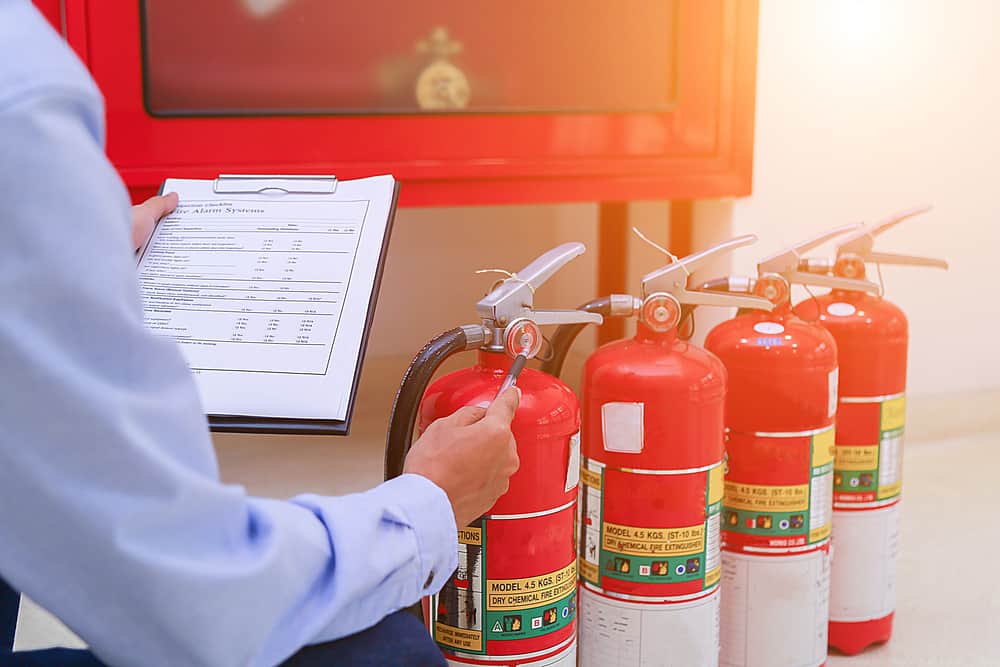
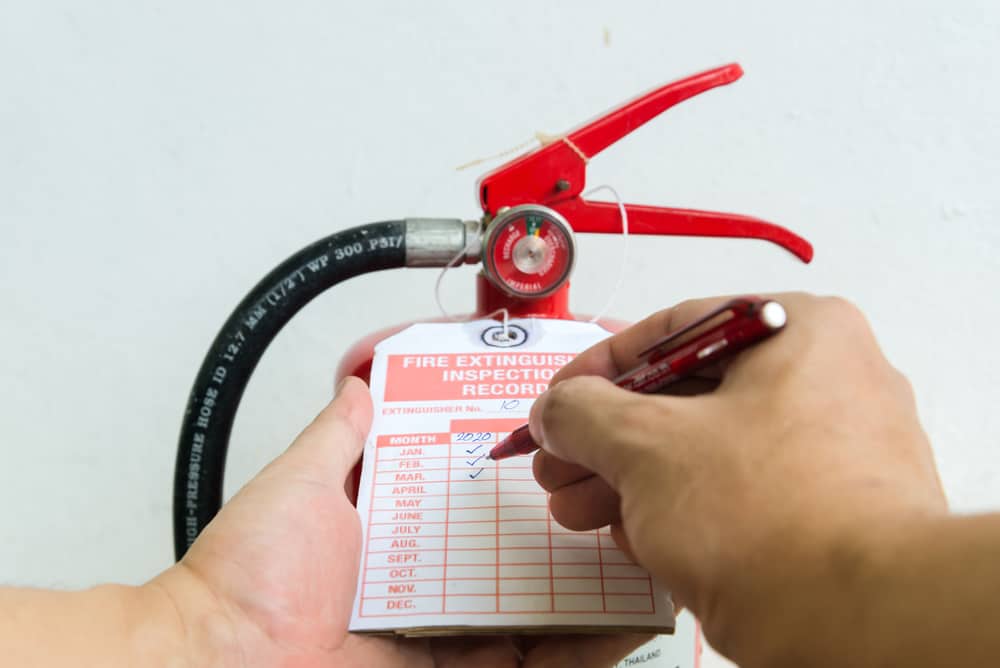
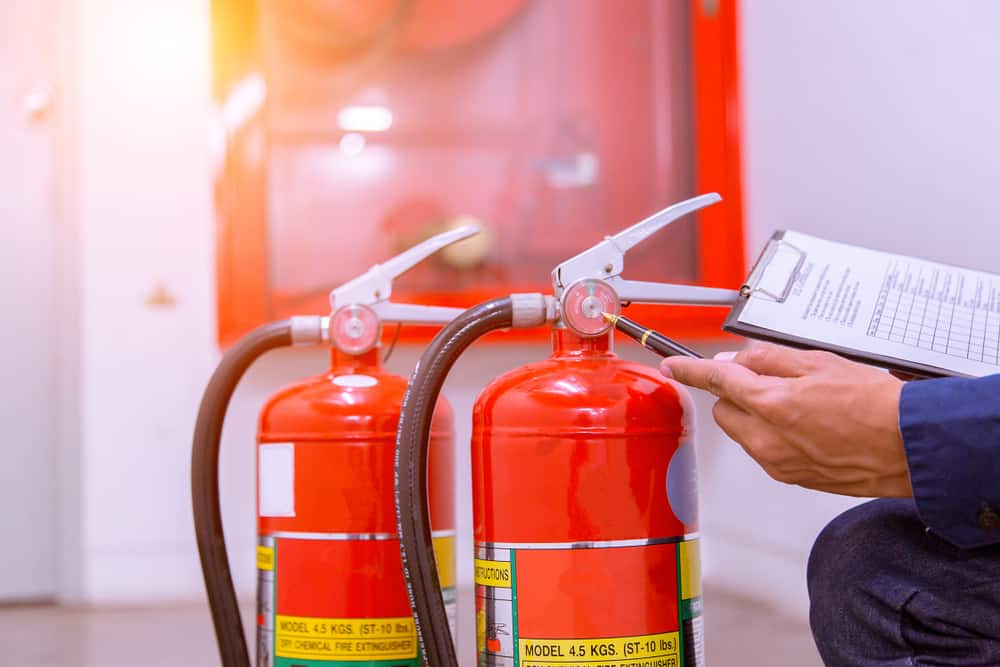
At the federal level, OSHA 1910.157 governs portable fire extinguishers in virtually every American workplace. It closely mirrors the requirements in NFPA 10 — the national standard that sets rules for extinguisher selection, installation, inspection, and maintenance. NFPA 10 requires annual professional inspection of all portable extinguishers and monthly visual checks by building staff. These aren’t optional.
The 2024 edition of NFPA 101 expanded extinguisher requirements to include both new and existing assembly occupancies — meaning some businesses that weren’t previously required to have extinguishers now are.
For statewide resources, the New York State Division of Homeland Security and Emergency Services (DHSES) publishes fire safety and prevention guidance for businesses through their Office of Fire Prevention and Control. Their resources are available at dhses.ny.gov/fire. This is particularly useful for Long Island businesses that want to understand how the NYS Fire Code applies to their operations outside of NYC jurisdiction.
Finally, the National Association of Fire Equipment Distributors (NAFED) sets industry guidelines that reputable fire protection companies follow alongside FDNY, OSHA, and NFPA standards. When you’re vetting a fire safety supplier, asking whether they follow NAFED guidelines is a reasonable question — and a company that knows what NAFED is will give you a straight answer.
Local Fire Safety Organizations and Business Resources Worth Knowing
Beyond the regulatory agencies, there are several Long Island business and community organizations that touch on fire safety compliance in ways that are worth knowing about. Some publish compliance guides. Some connect businesses to vetted service providers. And some are simply good to have on your radar when you’re navigating the compliance landscape for the first time.
The Long Island Association is the region’s largest business advocacy organization, covering Nassau and Suffolk Counties. They regularly engage with policy issues that affect local businesses — including fire and safety regulations — and their network is a useful resource for business owners trying to stay current on regulatory changes that affect their operations.
Nassau and Suffolk Chamber Networks: Underused Resources for Compliance Guidance
Most business owners think of their local chamber of commerce as a networking organization. But chambers — particularly the Nassau Council of Chambers of Commerce and the various town-level chambers across Suffolk County — often serve as informal clearinghouses for practical business compliance information.
When a new fire code requirement rolls out, or when a county office changes its inspection process, chambers are frequently among the first to communicate that to their members. This matters in a market like Long Island, where the regulatory landscape can shift at the county level without a lot of fanfare.
The Nassau County Fire Commission coordinates county-level fire safety regulations, inspections, and educational programs for local businesses. Their work doesn’t always make headlines, but the policy changes they implement have real consequences for business owners in Nassau. Staying connected to your local chamber gives you a channel for hearing about those changes before they catch you off guard.
For businesses in the Route 110 corridor — the industrial and commercial zone running through Deer Park, Melville, and Farmingdale — this is especially relevant. That corridor is one of the most concentrated commercial zones in western Suffolk County, with a mix of warehouses, manufacturing operations, and distribution facilities that each carry their own fire safety equipment requirements.
Businesses in that area often have more complex compliance needs than a typical retail or office environment, and local chamber connections can help them stay ahead of regulatory updates that affect industrial occupancies specifically. It’s also worth noting that chambers of commerce can sometimes help you identify whether a fire safety supplier operating in your area is known to the local business community — an informal but useful layer of vetting on top of the official licensing verification steps described earlier.
How to Use These Resources Before You Get a Violation — Not After
The most common mistake Long Island business owners make with fire safety compliance is treating it as a reactive problem. They wait until an FDNY inspector or a county fire marshal flags something, and then they scramble. By that point, the violation is already on record, a correction deadline is already set, and the cost — in time, money, and stress — is already higher than it needed to be.
The resources listed in this piece exist specifically to help you get ahead of that scenario. The Nassau County Fire Marshal’s contractor list tells you whether your service company is authorized before you sign anything. The FDNY Approved Companies List tells you whether a provider servicing your NYC locations is operating legally.
NFPA 10 tells you exactly what inspection and maintenance schedule your extinguishers require — annual professional inspection, monthly visual checks by building staff, and hydrostatic testing on a schedule that varies by extinguisher type (every five years for most pressurized water, CO₂, and wet chemical units). And DHSES gives you a statewide framework for understanding which rules apply to your Long Island locations specifically.
One thing worth understanding: hydrostatic testing and annual inspection are not the same thing. A lot of business owners assume that if their extinguisher has been inspected recently, it’s fully compliant. But hydrostatic testing — which checks the structural integrity of the extinguisher cylinder under pressure — is required on a separate schedule that most inspectors will catch only if they’re actually doing their job. If your last service company didn’t mention hydrostatic testing, that’s worth following up on.
The practical takeaway is this: compliance is easier to manage when you know which agencies govern your specific locations, which certifications your service provider needs to hold in each jurisdiction, and what your inspection and testing schedule actually requires. That’s what this resource list is for. Use it proactively, and a violation notice becomes something that happens to businesses that weren’t paying attention — not yours.
Fire Safety Compliance on Long Island: Where to Start If You're Not Sure Where You Stand
If you’ve made it this far and you’re not entirely sure whether your business is fully compliant — with the right extinguishers, properly inspected, serviced by a certified provider — that uncertainty is worth acting on. The good news is that getting clarity doesn’t have to be complicated.
Start with the basics: pull up the Nassau County contractor list or the FDNY Approved Companies List and verify that your current service provider is on it. Check when your last annual inspection was done and whether hydrostatic testing is due. If you’re not sure which fire code applies to your specific location, the DHSES website and your county fire marshal’s office are the right places to start.
And if you want someone who already knows both the Long Island and NYC regulatory landscape — and has for over 35 years — we’re available to walk through it with you. M&M Fire Extinguishers Sales & Services, Inc. offers free on-site estimates and same-day service, and we’re reachable any time, day or night.
Related posts