Annual Fire Inspection Rules: OSHA vs. NFPA 10 Unpacked for Nassau County
August 28, 2026
Nassau County Fire Extinguisher Rules: Counterfeit Tag Threat
September 3, 2026
Summary:
Most business owners in Suffolk County assume that if a fire extinguisher company is licensed somewhere in New York, they’re covered everywhere. That’s a reasonable assumption. It’s also wrong—and it’s the kind of mistake that turns a routine compliance task into a violation notice, a fine, and a scramble to get everything re-done by a company that’s actually authorized to work here.
Suffolk County has its own licensing board, its own registration requirements, and its own enforcement structure. Understanding how that works isn’t complicated, but it does matter—especially if you’re running a restaurant, warehouse, retail space, or any commercial property in western Suffolk.
Local Fire Extinguisher Inspection Licensing in Suffolk County
Suffolk County is governed by the Suffolk County Fire Extinguisher Licensing Board—commonly called the FELB. This is a real, named regulatory body administered by Suffolk County Fire-Rescue & Emergency Services. It is not a branch of the FDNY, and it is not connected to Nassau County’s licensing structure. It exists specifically to regulate who can legally sell, install, and service portable fire extinguishers within Suffolk County’s borders.
A company that holds an FDNY Certificate of Fitness can legally service extinguishers in New York City. A company registered in Nassau County can legally work in Nassau County. Neither of those credentials automatically extends to Suffolk County. To work here, a company must hold a separate Certificate of Registration issued by the FELB—full stop. Businesses should make sure the company handling their fire extinguisher repair and servicing is properly authorized to perform the work in Suffolk County.
What Happens If Your Provider Isn't Registered with the Suffolk County FELB?
Here’s where it gets expensive. If a fire extinguisher company services your equipment without holding a valid Certificate of Registration from the Suffolk County FELB, that service is unlicensed under Suffolk County law. It doesn’t matter how professional the technician seemed. It doesn’t matter that the tag looks current. In the eyes of the fire marshal, it’s as if the inspection never happened.
Under Suffolk County’s code, any person who installs or services fire extinguishers without the required license is guilty of a misdemeanor—subject to a fine of up to $5,000, imprisonment for up to one year, or both. Each violation is treated as a separate offense. That criminal exposure falls on the unlicensed provider, but the compliance failure falls on you as the business owner. You’re the one holding a non-compliant extinguisher when the fire marshal walks in.
And fire marshals do walk in. In Suffolk County, inspections are triggered by routine commercial property sweeps, permit applications, certificate of occupancy requests, and post-fire investigations. When a fire marshal checks an extinguisher tag and the servicing company doesn’t appear on the FELB’s Certificate of Registration Holders list, they write the violation against the property—not the service company.
You then face fines starting at $300 per extinguisher, potential insurance complications, and the cost of having a properly licensed company come back and re-inspect every unit from scratch. The math is straightforward: a typical commercial space might have six to ten extinguishers. At $300 to $1,000 per unit in non-compliance fines, that’s a potential exposure of $3,000 to $10,000 from a single inspection sweep.
It’s also worth noting that your insurance carrier may independently require proof of annual inspection—and a tag from an unlicensed company won’t satisfy that requirement either. Insurance renewals are a common trigger for compliance audits, and a business that can’t produce valid inspection records can find itself facing policy complications at exactly the wrong moment.
How to Verify That Your Fire Extinguisher Company Is Licensed in Suffolk County
The Suffolk County FELB publishes a public Certificate of Registration Holders list. It’s available through the Suffolk County government website, and any business owner can check it. If you want to verify that your current provider is authorized to work in Suffolk County, look up the company name on that list. If they’re not on it, they shouldn’t be touching your extinguishers.
When you’re evaluating a new provider, ask directly: “Do you hold a Certificate of Registration from the Suffolk County Fire Extinguisher Licensing Board?” A legitimate company will know exactly what you’re asking and will be able to confirm it immediately. If the answer is vague—or if they pivot to talking about their FDNY certification or their Nassau County license—that’s a signal worth paying attention to.
This matters more in Suffolk County than most business owners realize, because the county’s regulatory structure is genuinely different from New York City’s. NYC operates under a single, centralized enforcement authority in the FDNY. Suffolk County has 109 independent volunteer fire departments operating alongside a county fire marshal and town-level fire marshals. The Town of Babylon’s Fire Marshal’s Office and Port Jefferson Village’s Fire Marshal both publish official FAQs stating the same thing: fire extinguishers must be inspected by a licensed contractor, and that contractor must be licensed by Suffolk County.
Local enforcement knowledge matters here in a way it simply doesn’t in a more centralized system. A company based in Queens or Nassau that “also services” Suffolk County may hold the correct FELB registration. But they won’t know your local fire marshal’s enforcement patterns, the specific requirements for your town’s fire district, or the nuances of how compliance is actually verified in western Suffolk’s commercial corridor. That institutional knowledge comes from operating here—not just driving here.
Fire Extinguisher Recertification: What's Actually Required and When
“Recertification” is one of those words that gets used loosely in this industry. Most business owners hear it and think of the annual inspection—the technician who shows up, checks the gauge, updates the tag, and leaves. That’s part of it. But the full recertification lifecycle for a commercial fire extinguisher involves three distinct service intervals, each with its own requirements and each requiring a properly licensed provider in Suffolk County.
Getting clear on what each interval involves—and when it’s due—is the most practical thing a business owner can do to stay ahead of compliance issues before they become enforcement issues.

Annual Fire Extinguisher Inspection: What a Certified Technician Actually Checks
NFPA 10—the national standard for portable fire extinguishers, adopted in New York—requires annual maintenance performed by a certified technician. This is separate from the monthly visual checks that building staff can do themselves and must log for a minimum of 12 months. The annual inspection has to come from a professional, and in Suffolk County, that professional’s company must hold a Certificate of Registration from the FELB.
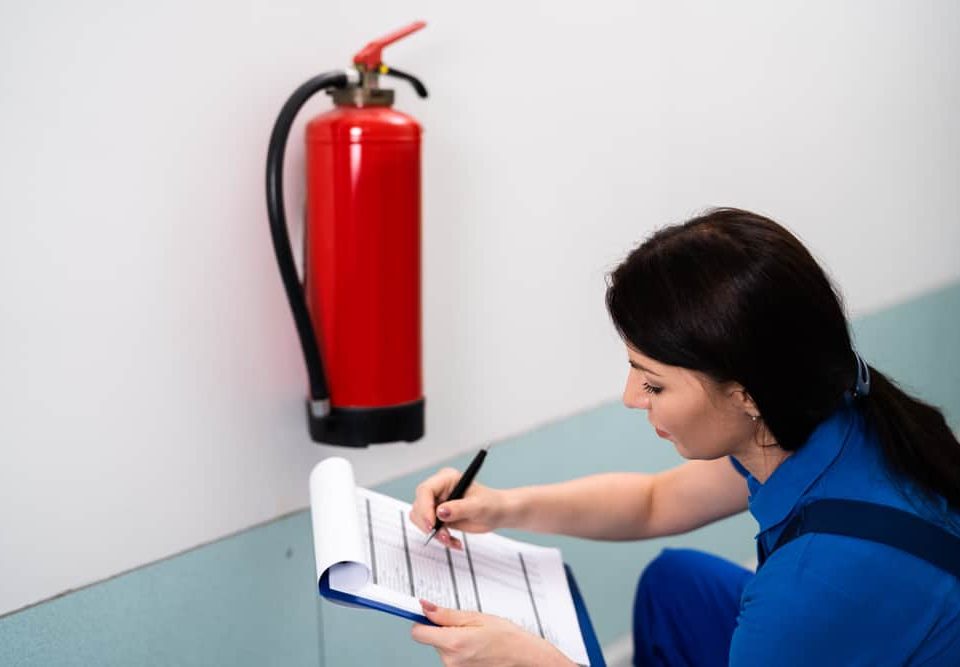
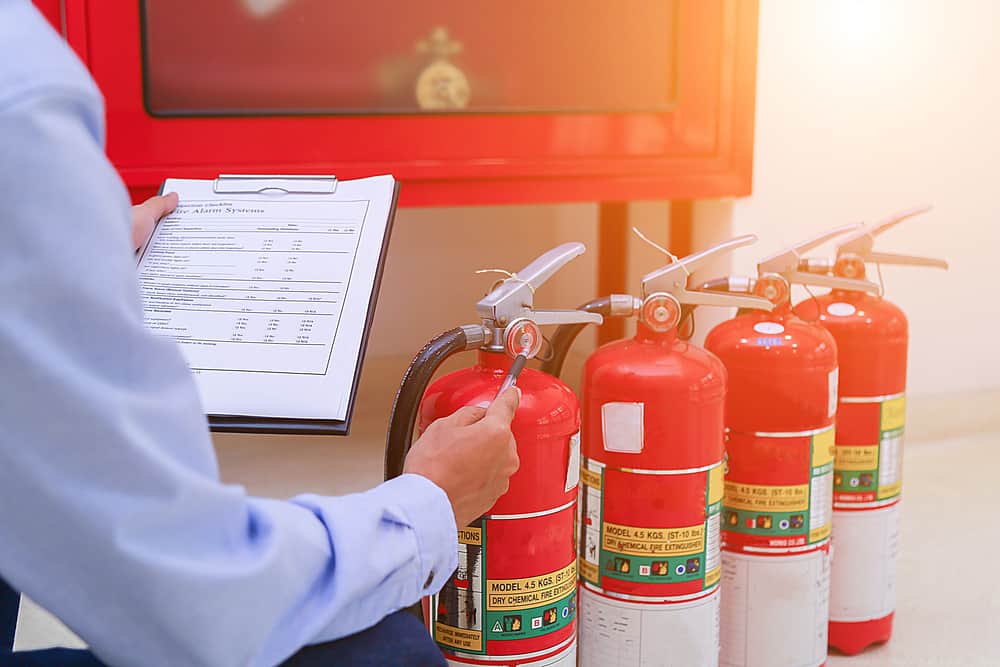
A legitimate annual inspection covers more than a quick look at the gauge. The technician verifies that the unit is in its designated location and properly mounted, checks the pressure gauge reading, inspects the physical condition of the cylinder, hose, and nozzle, confirms the safety seal and tamper indicator are intact, verifies the pull pin is present and unobstructed, checks the weight to confirm a full charge, and confirms the label is legible and the unit is accessible with no obstructions. The service tag is then updated with the date, technician name, and company—and documentation is provided to you.
That last part matters. The tag is visible proof of compliance, but the documentation behind it is what satisfies a fire marshal audit or an insurance carrier’s request for proof of inspection. If your current provider isn’t leaving you with proper NFPA 10-compliant service records, that’s a gap worth addressing before someone else asks for them.
The cost of a professional annual inspection in the Suffolk County and Long Island market typically runs $40 to $100 per visit, with per-unit fees generally ranging from $5 to $15 for standard extinguishers. Specialized units—like the wet chemical Class K extinguishers required in commercial kitchens—can run higher. Free on-site estimates are the cleanest way to get an accurate number for your specific facility before anyone shows up.
6-Year Maintenance and 12-Year Hydrostatic Testing: The Service Intervals Most Businesses Miss
The annual inspection is the most visible part of fire extinguisher compliance, but it’s not the whole picture. Stored-pressure dry chemical extinguishers—the standard ABC units found in most commercial spaces—require a full internal maintenance every six years under NFPA 10 and OSHA’s 29 CFR 1910.157. This means the unit is fully discharged, internally inspected, and reassembled. It’s a more intensive service than the annual check, and it cannot be skipped just because the annual tags are current.
At the 12-year mark, those same extinguishers require hydrostatic pressure testing to verify that the cylinder can still safely hold pressure. Units that fail hydrostatic testing are removed from service and replaced. Non-rechargeable disposable extinguishers must be removed from service at 12 years regardless of their apparent condition—there’s no test that extends their service life.
Many businesses in Suffolk County are current on their annual inspections but years overdue on 6-year maintenance or 12-year testing—often because no one ever explained that these intervals exist, or because a previous provider never flagged them. A facility with 30 extinguishers should budget $1,500 to $2,500 for 6-year maintenance work. That’s a known, plannable cost.
The alternative—having a fire marshal or insurance auditor identify overdue units during an inspection—turns a plannable cost into an emergency expense, usually at the worst possible time. Suffolk County’s restaurant and food service industry is particularly exposed here, because Class K wet chemical extinguishers—required in commercial kitchens under NFPA 10—operate on a different hydrostatic testing cycle than standard ABC units. A kitchen that’s been in operation for several years without a full service review may have extinguishers that are technically out of compliance on intervals the owner never knew existed.
The Route 110 corridor through Deer Park, Amityville, and Farmingdale has a dense concentration of food service operations and light industrial facilities where this kind of compliance gap is common. If you operate in that area or anywhere else in western Suffolk, a full compliance audit is worth the time investment.
Choosing the Right Fire Extinguisher Inspection Company in Suffolk County
The licensing question isn’t a technicality. In Suffolk County, it’s the difference between a valid inspection and a worthless one—and between a compliant business and a violation notice that costs you far more than the inspection ever would have.
Before you schedule your next fire extinguisher inspection, check the FELB Certificate of Registration Holders list. Ask your provider directly whether they hold a Suffolk County Certificate of Registration. And make sure whoever you’re working with understands the full service lifecycle—not just the annual tag, but the 6-year maintenance and 12-year hydrostatic testing intervals that most businesses don’t know they’re overdue for.
We’ve been based in Deer Park and serving Suffolk County businesses for over 35 years. If you have questions about where your extinguishers stand—or you want to make sure your current compliance is actually valid—we’re a straightforward call or message away.
Related posts