What to Expect During Your Professional Fire Extinguisher Service Appointment
March 10, 2026
Why 2026 is the Year of Sustainability: The Environmental Benefits of a Fire Extinguisher Recharge
March 12, 2026
Summary:
What Makes Fire Extinguisher Repair Different in New York
New York operates under some of the strictest fire safety regulations in the country. The FDNY responds to over 27,000 structural fires annually, many involving commercial properties. That’s why state and city regulations don’t just require fire extinguishers—they mandate how they’re serviced, who can service them, and how that service is documented.
Fire extinguisher repair in New York must be performed by companies holding valid FDNY portable fire extinguisher servicing company certificates. The technicians doing the actual work must hold W-96 Certificates of Fitness. These aren’t optional credentials. They’re legal requirements that directly impact whether your repairs count as compliant.
When your extinguisher needs repair—whether it’s pressure loss, a damaged hose, a faulty valve, or internal contamination—only a licensed company can legally restore it to working order and provide the documentation that proves it. Without that documentation, you have no proof of compliance when inspectors or insurance adjusters come calling.
How FDNY-Issued Tags Protect Your Insurance Coverage
Since June 2018, New York City has required FDNY-issued serialized tags for all fire extinguisher service and repair work. These tags include QR codes that inspectors can scan to verify authenticity, holograms that are virtually impossible to counterfeit, and barcodes that link directly to the approved company list.
Only licensed companies can purchase these tags from the FDNY. That means only licensed companies can legally repair your extinguishers in a way that satisfies insurance requirements and fire code compliance. If someone shows up with handwritten tags, generic stickers, or tags bearing another company’s name, your repair isn’t valid. You’re paying for service that won’t protect you when it matters.
This system exists because the New York City Department of Investigation discovered unlicensed businesses fraudulently placing tags from legitimate companies on equipment they’d never properly serviced. Business owners thought they were compliant. Insurance companies and fire marshals discovered otherwise—usually after a fire, during an inspection, or when violations were issued.
The financial consequences hit hard. FDNY fines range from $300 to $1,000 per extinguisher depending on violation severity. But the real cost isn’t the fine. It’s the potential business closure if you’re found with improperly serviced equipment during an inspection. It’s the insurance claim denial if a fire occurs and your documentation doesn’t hold up. It’s the liability exposure if someone gets hurt and your fire safety equipment wasn’t legally maintained.
When you work with an FDNY-approved company for fire extinguisher repair, you’re not just fixing equipment. You’re buying compliance, documentation, and peace of mind. The right company handles all the paperwork, ensures proper tagging, and maintains records that satisfy both FDNY requirements and your insurance company’s demands.
Common Fire Extinguisher Repairs That Require Certified Technicians
Fire extinguisher repair isn’t just about topping off pressure or slapping on a new tag. These are pressure vessels that demand respect and proper handling. When something goes wrong, it usually falls into categories that require professional expertise and specialized equipment.
Pressure problems are the most common culprits. Your extinguisher might be losing pressure due to a faulty valve, damaged O-ring, or compromised seal. Sometimes the gauge itself has failed, showing incorrect readings that make you think the unit is functional when it’s not. A certified technician can diagnose the actual problem, source the correct replacement parts, and restore proper pressure while documenting the repair.
Physical damage—dents, corrosion, damaged hoses, or compromised cylinders—requires careful assessment to determine if repair is viable or if replacement makes more sense. Not every damaged extinguisher can be repaired. Some need to be taken out of service immediately. Only trained technicians can make that call safely and in compliance with NFPA 10 standards.
Internal contamination is trickier to spot but just as serious. Moisture, debris, or chemical breakdown inside the cylinder can render your extinguisher useless when you need it most. This is why proper diagnosis matters before any repair work begins. A visual inspection might show a unit that looks fine externally while being completely compromised internally.
In New York State, stored pressure fire extinguishers must undergo internal examination every six years. This six-year maintenance involves discharging the extinguisher and conducting a thorough examination of mechanical parts, extinguishing agent, and expelling means. When applicable maintenance procedures are done during periodic recharging or hydrostatic testing, the six-year requirement begins from that date.
Hydrostatic testing—pressure testing to verify cylinder strength—is required every 5 to 12 years depending on extinguisher type. Dry chemical extinguishers typically need testing every 12 years, while CO2 extinguishers require it every 5 years. This testing must be performed by certified professionals with proper equipment. There’s no workaround, no shortcut, no DIY option that satisfies legal requirements.
Insurance Requirements for Fire Extinguisher Documentation in NY
Your business insurance policy includes fire coverage. That coverage comes with conditions. One of those conditions—often buried in the fine print—requires you to maintain fire safety equipment according to local codes and regulations. When you don’t, your insurance company has grounds to deny claims.
Insurance companies don’t just take your word that equipment was maintained. They verify. After a fire, adjusters examine inspection tags, review maintenance records, and confirm that service was performed by licensed companies. If your fire extinguisher repair was done by an unlicensed provider, if the tags aren’t FDNY-issued, if the documentation doesn’t exist or doesn’t meet standards—you’ve potentially violated your policy conditions.
That violation gives insurance companies leverage to reduce payouts or deny claims entirely. The logic is straightforward from their perspective: you agreed to maintain equipment properly as a condition of coverage. You didn’t. Therefore, the claim isn’t valid under the policy terms.
What Insurance Adjusters Look for After a Fire
When a fire occurs at your property, insurance adjusters don’t just assess damage. They investigate whether you maintained the property in a way that complied with fire safety regulations. Fire extinguishers are one of the first things they check.
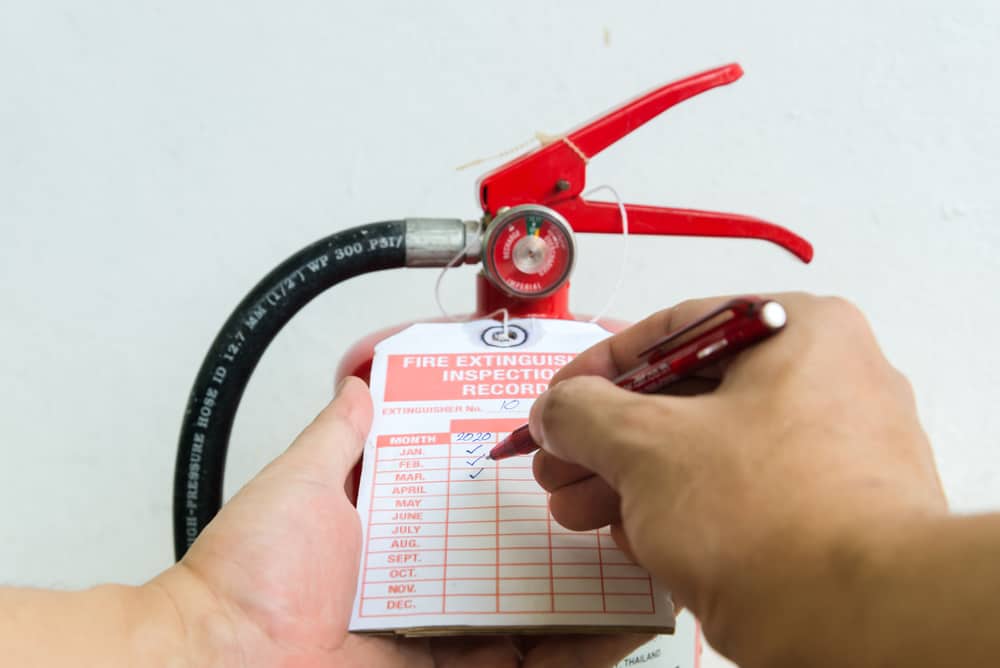
Adjusters examine inspection tags to verify they’re current, legitimate, and from FDNY-approved companies. They scan QR codes to confirm authenticity. They review maintenance records to ensure annual inspections were performed, six-year maintenance was completed when required, and hydrostatic testing happened on schedule. They check that extinguishers were properly placed according to NFPA 10 standards—within 75 feet of travel distance for Class A hazards, 50 feet for Class B.
If any of these elements are missing or non-compliant, adjusters document it. That documentation becomes part of their assessment of whether you fulfilled your obligations under the insurance policy. In some cases, non-compliance doesn’t void the entire claim—but it can significantly reduce the payout. In other cases, particularly if the fire spread because extinguishers weren’t functional, the claim can be denied outright.
The risk extends beyond the immediate claim. Insurance companies can also use evidence of non-compliance to cancel your policy, refuse renewal, or increase premiums substantially. Once you’re flagged as a high-risk client who doesn’t maintain proper fire safety equipment, finding affordable coverage becomes significantly harder.
This is why working with licensed companies for fire extinguisher repair isn’t just about passing inspections. It’s about protecting your financial interests if the worst happens. The few hundred dollars you might save by using an unlicensed provider doesn’t compare to the hundreds of thousands you could lose if a claim is denied.
How Proper Documentation Protects You During Insurance Audits
Insurance audits don’t just happen after fires. Many commercial policies include periodic audits where insurance companies verify that you’re maintaining the property according to policy conditions. Fire safety equipment is always part of these audits.
During an audit, you need to produce current inspection tags, maintenance records, and proof that service was performed by licensed companies. If you can’t produce this documentation, or if the documentation doesn’t meet FDNY standards, you’re potentially in violation of your policy. Insurance companies can use this as grounds to increase premiums, reduce coverage limits, or cancel the policy entirely.
Proper documentation from certified fire extinguisher repair creates an audit trail that protects you. Every service call should generate records that include the date of service, the technician’s identification, the work performed, parts replaced, pressure readings, and the new inspection tag number. These records should be maintained for the life of the extinguisher or until the next service, whichever is longer.
When you work with us at M&M Fire Extinguishers Sales & Services, Inc., this documentation happens automatically. We maintain records that satisfy both FDNY requirements and insurance company demands. You don’t have to chase down paperwork or worry about whether your documentation will hold up under scrutiny. It’s built into our service.
This level of documentation also protects you from liability if someone is injured during a fire. If a lawsuit alleges that your fire safety equipment wasn’t properly maintained, you need records that prove otherwise. Without those records, you’re vulnerable to claims that could have been easily defended with proper documentation.
The peace of mind that comes from knowing your fire extinguisher repair is properly documented, performed by licensed technicians, and compliant with all applicable regulations is worth far more than the cost of the service. You’re not just maintaining equipment. You’re protecting your business, your insurance coverage, and your legal standing.
Protecting Your Business with Certified Fire Extinguisher Repair
Fire extinguisher repair in New York isn’t a task you can delegate to the lowest bidder. It’s a legal requirement tied directly to your insurance coverage, your compliance with fire codes, and your protection from liability. When you cut corners, you’re not saving money. You’re creating risk that far exceeds any short-term savings.
Working with FDNY-approved companies ensures your repairs are performed by certified technicians, documented properly, and compliant with all applicable regulations. You get valid inspection tags that pass fire marshal scrutiny. You get maintenance records that satisfy insurance companies. You get equipment that actually works when you need it.
If you’re operating a business in Long Island, NY, Queens County, NY, Kings County, NY, New York County, NY, Bronx County, NY, or Richmond County, NY, don’t leave your fire safety compliance to chance. We have over a decade of experience serving commercial and residential properties across the region with certified fire extinguisher repair, inspection, installation, and maintenance services that keep you protected and compliant.