
Monthly Fire Extinguisher Inspection Form: Free NY-Ready PDF Template
July 30, 2026
Fire Extinguisher Checklist Template for NY Businesses and Property Managers
August 6, 2026
Summary:
If you operate a business in Nassau County, you’ve probably wondered whether you’re following the same fire code as properties in Manhattan or Brooklyn. The short answer? No. And that difference matters more than most business owners realize.
Nassau County employs a more centralized approach to fire protection and safety, largely overseen by the Nassau County Fire Commission. NYC operates under its own fire code administered by the FDNY. The jurisdictional split creates real compliance challenges, especially if you’re managing properties across multiple locations or trying to understand which rules actually apply to your Nassau County building.
Here’s what you need to know about navigating fire safety regulations in Nassau County versus NYC, and how understanding these differences keeps your business compliant, insured, and operational.
Fire Code Requirements: Understanding the Regulatory Framework
Both Nassau and Suffolk Counties follow the New York State Uniform Fire Prevention and Building Code as a baseline for fire safety. That’s the foundation. But what happens on top of that foundation varies significantly depending on where your property sits.
The Nassau County Fire Prevention Ordinance establishes uniform regulations for the control of fire hazards and for the enforcement of such regulations in accordance with the recommendations of the Nassau County Fire Commission. This ordinance adds county-specific requirements that go beyond state minimums. It sets forth requirements for the storage and handling of flammable and combustible liquids, propane, and oxidizers, and establishes requirements for applications, plans, and fees for the review, inspection, testing, and acceptance of required life safety systems and equipment.
New York City, meanwhile, operates under the NYC Fire Code enforced by the FDNY. The city has its own inspection protocols, tagging systems, and compliance timelines that differ from Nassau County’s approach. Understanding these differences is essential for fire code compliance and avoiding violations caused by applying the wrong local requirements.
How Nassau County's Centralized System Works
Nassau County employs a more centralized approach to fire protection and safety, largely overseen by the Nassau County Fire Commission, which coordinates county fire safety regulations, inspections, and educational programs, and the commission’s structure facilitates uniformity in fire safety standards, particularly in densely populated and multi-family residential areas, which have seen stricter regulations in recent years.
What does centralized enforcement actually mean for your business? It means that whether you’re operating in Hempstead, Garden City, or Mineola, you’re dealing with the same set of county-level requirements administered by the same authority. Nassau County’s centralized Fire Commission model creates more predictable requirements across different municipalities, and the county coordinates inspections, standards, and educational programs, delivering consistency for businesses operating multiple Nassau locations.
The Fire Marshal’s Office plays a central role in this system. The Fire Marshal’s Office is pivotal in maintaining fire safety across the county and conducts regular inspections of commercial properties, ensuring compliance with state and county-specific regulations. When you receive an inspection notice or violation in Nassau County, it’s coming from this centralized office rather than from individual municipal fire departments.
This centralized structure offers significant advantages for businesses. Nassau’s approach offers businesses greater predictability, as compliance is uniform throughout the county, providing a predictable and standardized approach to fire safety for businesses, reducing confusion and ensuring consistency across different properties. You’re not navigating different requirements in every town or village. The rules stay consistent, the inspection procedures follow the same protocols, and the documentation requirements remain uniform.
Recent years have brought stricter regulations, particularly for densely populated areas and multi-family residential properties. The Fire Marshal’s Office conducts regular commercial property inspections, ensuring compliance with state and county-specific regulations while offering educational programs that keep business owners informed. These educational programs represent a proactive approach to compliance rather than purely punitive enforcement.
NYC's Fire Code Structure and FDNY Enforcement
New York City operates under a completely separate fire code framework. The FDNY enforces the NYC Fire Code, which has its own inspection schedules, violation structures, and compliance requirements distinct from Nassau County’s ordinance.
Currently code enforcement is based on the 2014 New York City Fire Code and NFPA 25 (2011 edition). The city requires specific tagging systems for fire extinguishers, has its own Certificate of Fitness requirements for personnel, and maintains different inspection frequencies for various types of equipment and systems.
The FDNY’s enforcement approach differs from Nassau County’s centralized model. While Nassau County coordinates through the Fire Commission and Fire Marshal’s Office, NYC enforcement happens through FDNY inspectors who work directly with individual properties. The FDNY conducts inspections that examine buildings, structures, facilities, vehicles and other locations in New York City, and the purpose of an inspection is to ensure that code, laws, rules or regulations are being enforced to keep the public safe.
Documentation requirements also differ. NYC mandates specific forms, inspection tags, and reporting procedures that don’t necessarily align with Nassau County’s requirements. If you operate properties in both jurisdictions, you’re managing two separate compliance systems with different timelines, different inspection protocols, and different documentation standards.
The practical impact shows up in daily operations. A fire extinguisher inspection that satisfies Nassau County requirements might not meet FDNY standards for tagging and documentation. Your insurance company and the FDNY mandate that fire extinguishers are inspected yearly to ensure they are fully serviced, and failure to have your fire extinguishers serviced can result in fines, closures to your business and suspension of insurance. The inspection itself needs to follow jurisdiction-specific protocols.
Business owners managing properties across both Nassau County and NYC quickly learn that what works in one location doesn’t automatically transfer to the other. The inspection companies you hire need proper licensing for each jurisdiction. The documentation you maintain needs to satisfy different authorities. And the compliance timelines you track need to account for jurisdiction-specific deadlines.
Understanding these differences isn’t just administrative detail. It’s the difference between smooth operations and unexpected violations that can shut down your business while you scramble to bring everything into compliance.
Commercial Fire Safety Compliance: What Your Business Must Do
As business owners, individuals and residents of Nassau County, it is required that you adhere to all provisions of the Nassau County Fire Code. That’s the legal requirement. But what does adherence actually look like in practice?
Commercial fire safety compliance breaks down into several key areas: fire detection and suppression systems, fire extinguisher maintenance, emergency egress requirements, hazardous materials storage, and documentation. Each area has specific requirements that vary by building type, occupancy classification, and square footage.
The Nassau County Fire Code establishes uniform regulations in conjunction with the recommendations of the Nassau County Fire Commission for the fire and life safety standards of Nassau County businesses, buildings, restaurants, residents and individuals, and is designed to implement the requirements for Nassau County fire detection and suppression systems, which include Fire Sprinkler Systems, Fire Alarm Systems, Fire and Smoke Detection Systems and Automatic Fire Extinguishing Systems.
The compliance burden falls directly on property owners and business operators. You’re responsible for maintaining systems, scheduling inspections, and keeping documentation current.
Fire Inspection Requirements for Long Island Businesses
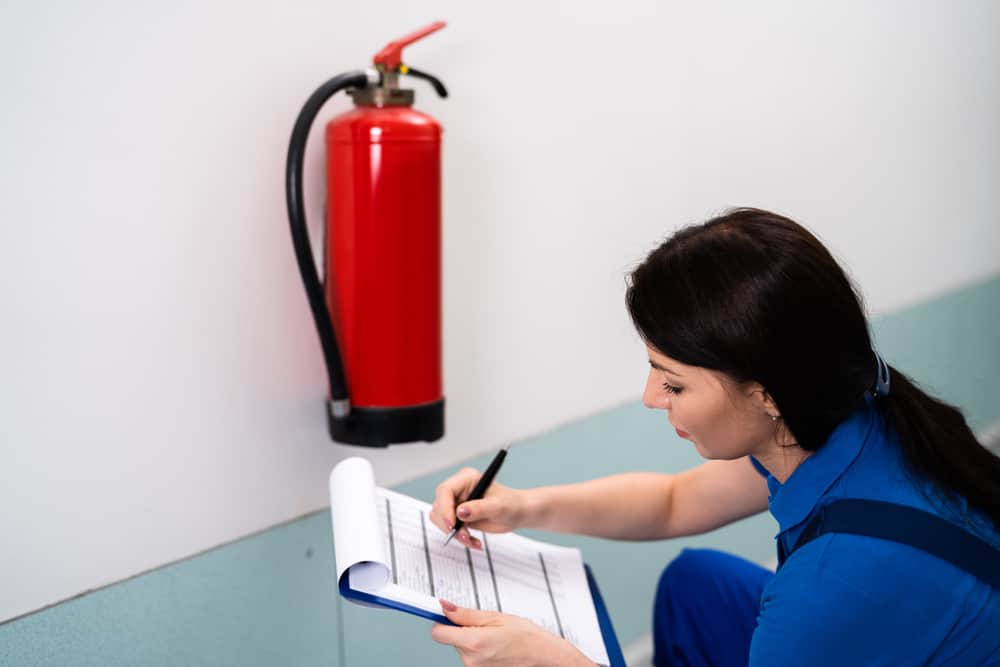
Fire extinguishers in Nassau County Long Island must be inspected yearly to maintain adequate insurance, business licensing and fire safety and fitness code. That annual inspection represents the minimum requirement. Depending on your business type and the systems installed, you may need more frequent inspections for specific equipment.
Nassau County’s Fire Prevention Ordinance establishes uniform regulation for the control of fire hazards and for the enforcement of such regulations in accordance with the recommendations of the Nassau County Fire Commission, and most inspection, testing and maintenance related procedures are based on NFPA 25 (2014 edition). NFPA standards provide the technical framework that Nassau County adopts for inspection protocols.
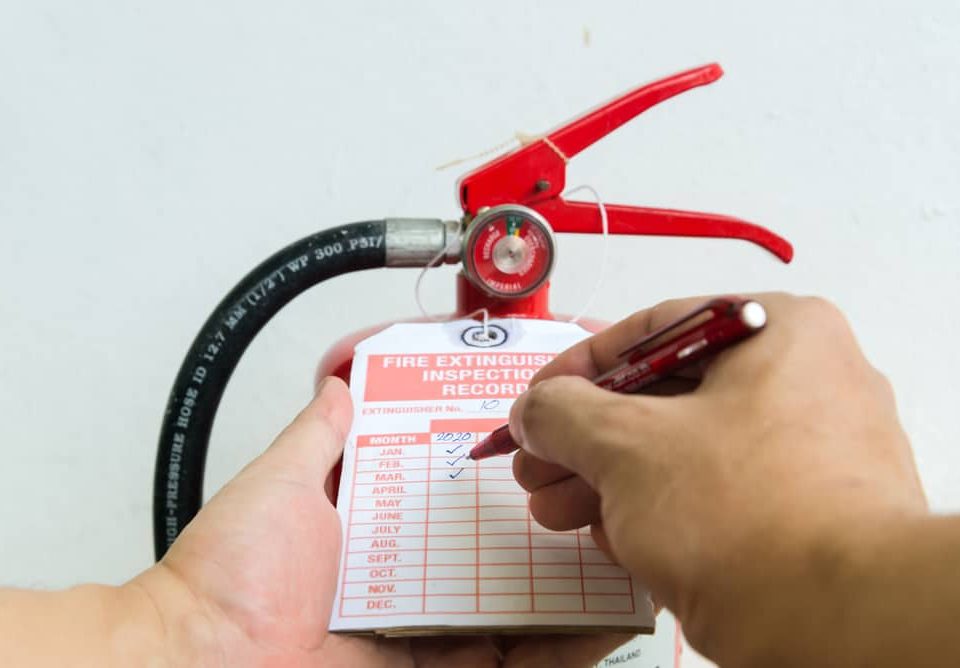
Fire extinguisher inspections must be performed by certified, licensed companies. A fire extinguisher inspection is to certify that the portable fire extinguisher meets the requirements of pressure, fill, and no visible aging, and a certified and insured fire protection technician will make sure the hose is not blocked, make sure there is adequate pressure, inspect the fire extinguisher for damage and make sure that the extinguisher is still full, and the fire extinguisher inspection tag from a licensed fire extinguisher protection company will certify that it has been inspected within the year and month it was dated.
The inspection tag itself carries legal weight. It serves as documentation during fire marshal visits and insurance inspections. A tag that’s even one day expired creates the same violation as a tag that’s been expired for six months. There’s no grace period, no “close enough” standard. The date on the tag either falls within the 12-month window or it doesn’t.
Beyond fire extinguishers, your property may require inspections for sprinkler systems, standpipes, fire alarm systems, emergency lighting, exit signage, and specialized suppression systems for commercial kitchens or server rooms. Each system has its own inspection frequency mandated by NFPA standards and adopted by Nassau County.
The NFPA and authorities requiring their standards be used break down these procedures into three categories: inspections, testing and maintenance, where inspections consist of routine visits visually confirming that all components of a system are operating as intended, testing involves simulating the use of these components and maintenance are repairs that prevent the system from failing in the event of an actual emergency.
Monthly visual inspections represent another layer of compliance. While annual professional inspections are mandatory, property owners or designated employees should conduct monthly visual checks to confirm that fire extinguishers remain accessible, properly mounted, fully pressurized, and undamaged. These monthly checks don’t replace annual professional inspections, but they help catch problems between service visits.
Documentation of all inspections, tests, and maintenance work must be maintained on-site and available for review by fire marshals or insurance inspectors. All fire alarm systems subject to this article and maintained in the Village of Farmingdale shall be inspected and tested annually or in accordance with the recommendations of the manufacturer, whichever requires the more frequent inspections, by a competent person, and written records of inspection shall be maintained on the premises protected.
Common Violations and Associated Penalties
Violations start at $300 per extinguisher and can reach $1,000 for repeat offenses or willful negligence. That’s just for fire extinguisher violations. Other fire code violations carry their own penalty structures.
Five Thousand Dollars ($5,000.00) for each and every offense represents the maximum penalty under Nassau County Fire Prevention Ordinance for serious violations. The actual penalty depends on the violation type, severity, and whether it’s a first offense or repeat violation.
The most common violations that businesses face include expired inspection tags, blocked access to fire extinguishers or exits, missing or damaged fire extinguishers, inoperable fire alarm components, and inadequate emergency lighting. If they have to sidestep anything, move something, or squeeze through a tight space, that’s a failed inspection item, and the extinguisher needs to be visible from normal travel paths, and the route to it must remain completely clear.
These violations don’t happen overnight. This failure happens gradually in busy facilities where a temporary stack of inventory becomes permanent, a cart gets parked “just for today” and stays there for weeks, new equipment gets installed without considering how it affects access to existing fire safety equipment, and nobody intentionally blocks fire extinguishers, but operational pressures create situations where accessibility becomes an afterthought.
Beyond financial penalties, violations create operational disruptions. Some violations can result in partial shutdowns until corrections are made. You can’t operate your business while under a shutdown order. Revenue stops while you scramble to bring everything into compliance and schedule re-inspections.
Insurance complications add another layer of consequences. Your insurance company will likely find out about violations, especially if they result in claims or lawsuits, which can affect your premiums or coverage eligibility, and in worst-case scenarios, insurance companies have denied claims related to fires where proper fire safety equipment wasn’t maintained according to regulations.
The violation process itself creates additional burdens. Many times Nassau County business owners, individuals and residents are unfamiliar with the Nassau County Fire Code, and find themselves facing violations under the Nassau County Fire Code that carry substantial fines and/or potential criminal charges without the knowledge required to properly resolve such allegations, and many Nassau County business owners are also unaware that general rule for corporate representation is that corporations are “artificial entities” and must only appear in court through an attorney when confronting a Nassau County Fire Code violation.
Court appearances, legal fees, and the time spent addressing violations add up quickly. The original $300 fine for an expired extinguisher tag becomes a much larger expense when you factor in lost productivity, legal representation, and the operational impact of increased scrutiny from fire marshals.
Prevention costs far less than remediation. Professional inspections typically run $40-$100 per visit, depending on how many extinguishers you have and their types, specialized units like wet chemical or Halotron systems can cost up to $300 to inspect due to the expertise required, but violations start at $300 per extinguisher and can reach $1,000 for repeat offenses or willful negligence. A $75 annual inspection is significantly cheaper than a $300-$1,000 violation, especially when you factor in all the secondary costs.
Staying Compliant with Nassau County Fire Safety Requirements
To ensure compliance, businesses must understand the key regulatory differences between Nassau’s uniform regulations and Suffolk’s localized adaptability, and staying informed about your property’s specific requirements isn’t just about following the rules—it’s about optimizing safety, minimizing risk, ensuring operational efficiency, and avoiding potential fines.
The compliance landscape in Nassau County offers more predictability than many other jurisdictions, but that doesn’t mean it’s simple. You’re still managing inspection schedules, maintaining documentation, ensuring equipment accessibility, and staying current with evolving regulations.
Working with experienced fire safety professionals who understand Nassau County’s specific requirements makes the difference between reactive scrambling and proactive compliance. You need service providers who know the Nassau County Fire Marshal’s expectations, who maintain proper licensing and insurance, and who can provide the documentation that satisfies both regulatory and insurance requirements.
For over 35 years, we at M&M Fire Extinguishers Sales & Services, Inc. have been helping Nassau County and Long Island businesses maintain compliance with fire safety regulations. With our 24/7/365 emergency service, same-day response capability, and comprehensive knowledge of Nassau County’s centralized fire code enforcement system, we provide the local expertise that keeps businesses protected and compliant.
Related posts