
FDNY Fire Extinguisher Tags: 3 Compliance Layers Most Owners Miss
July 30, 2026
Nassau and NYC Fire Safety Regulations Compared
August 4, 2026
Summary:
You searched for a form. That makes sense — you need to document your monthly fire extinguisher checks, and you want to do it right. What most business owners find out too late is that the form is only part of the picture. The monthly inspection log is a legal requirement under both NFPA 10 and OSHA, and missing documentation — even for an extinguisher that’s in perfect working order — can trigger an FDNY violation with real financial consequences. This guide gives you the form, explains exactly what goes on it, and makes sure you understand the one thing it cannot do for you.
Monthly Fire Extinguisher Inspection Log: What It Is and Why It's Required
Under NFPA 10 Section 7.2.1.2, every portable fire extinguisher must be inspected at least once every 30 days. OSHA’s 29 CFR 1910.157 says the same thing for any employer who provides extinguishers in the workplace. That means monthly inspections aren’t optional — they’re a federal and industry-standard requirement that applies to virtually every commercial space in New York.
What catches people off guard is the documentation piece. It’s not enough to glance at the extinguisher and move on. NFPA 10 requires that every manual inspection be recorded, including the date, the inspector’s initials, and the findings. In New York City, the FDNY requires this documentation to appear on the tag attached to the extinguisher or through an approved electronic method. No record means no proof — and no proof means a citable violation, even if the extinguisher itself is in perfect shape.
What Does a Monthly Fire Extinguisher Inspection Actually Check?
The monthly inspection is a visual walkthrough, not a technical teardown. Any trained employee can do it — no Certificate of Fitness is required for the monthly check in New York City. What matters is knowing what to look for and recording it consistently.
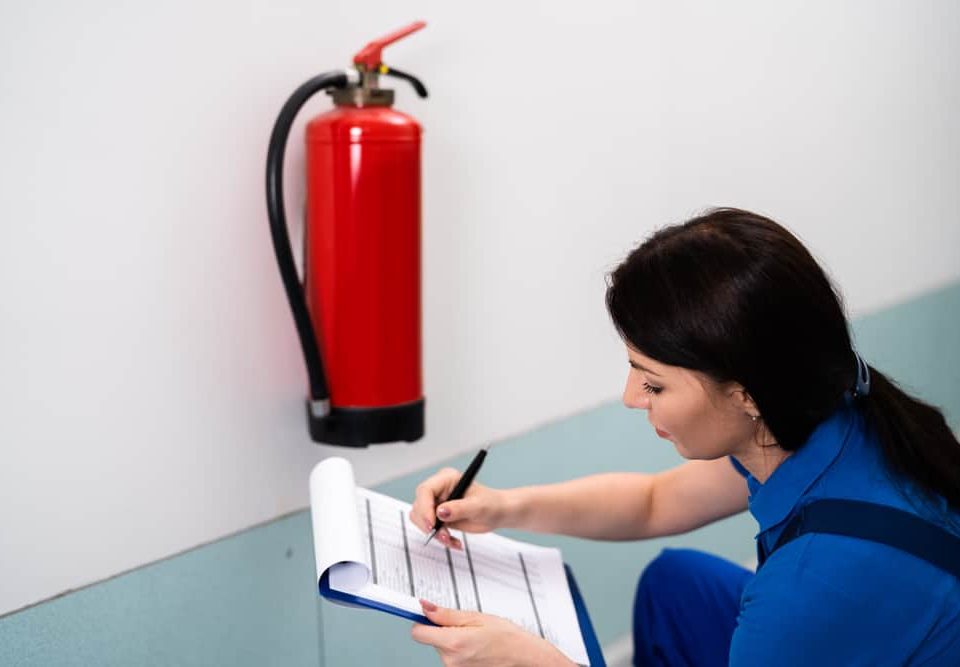
Here’s what the form needs to capture: First, confirm the extinguisher is in its designated location and that nothing is blocking access to it. An extinguisher stored behind boxes or inside a closet fails this check immediately. Second, verify the pressure gauge needle is sitting in the green (operable) zone. Improper pressure is the most common reason extinguishers fail — it accounts for nearly 40% of reported issues — so this is not a step to skim over.
Third, check that the pull pin is in place and the tamper seal or tamper indicator is intact and unbroken. A missing or broken seal suggests the extinguisher may have been discharged or tampered with, and it needs professional attention before the next use. Fourth, look at the physical condition of the cylinder — no dents, corrosion, or visible damage to the shell. Fifth, confirm the operating instructions on the nameplate are legible and facing outward. If someone needs to use that extinguisher in an emergency, they shouldn’t have to spin it around to read the label.
Finally, record the extinguisher’s location identifier, the date of the inspection, and the initials of whoever performed the check. That last part — the date and initials — is what makes the log legally defensible. Without it, the inspection might as well not have happened as far as the FDNY is concerned. In NYC, extinguishers must be mounted with the bottom at least four inches off the floor and the top no higher than five feet. If yours is sitting on the floor, that’s a mounting violation separate from the inspection log issue entirely.
Where the Monthly Log Lives — and Why It Can't Be in a Filing Cabinet
This is a detail that trips up a lot of otherwise diligent business owners. NFPA 10 requires that inspection records be kept either on a tag or label attached directly to the extinguisher, or on an inspection checklist maintained on file at the premises. The FDNY’s preference for NYC businesses is the tag method — the monthly log entries go on the back of the inspection tag that’s attached to the unit itself.
Why does this matter? Because when an FDNY inspector walks through your building, they’re looking at the extinguisher. They’re not waiting for you to run to the back office and pull a binder. If the documentation isn’t on or immediately with the unit, it might as well not exist for purposes of that inspection. A fire extinguisher monthly inspection log stored in a desk drawer three rooms away isn’t going to help you in the moment.
The practical implication is that the form you use — whether it’s a paper tag, a printed checklist posted near the unit, or an approved electronic system — needs to be accessible at the point of inspection. Some businesses with multiple extinguishers across a large space use a centralized log that lives near the main panel or building entrance, but the cleanest approach for most small and mid-size commercial spaces is a tag-based system where each unit carries its own record. OSHA also requires that these records be retained for a minimum of one year after the last entry. So even after a new annual inspection resets the cycle, the prior year’s monthly log needs to stay on file. That’s not a suggestion — it’s a retention requirement.
Monthly Inspection vs. Annual Inspection: Understanding the Full Compliance Picture
The monthly form handles the visual check — the things a trained employee can observe without any special equipment or credentials. But NFPA 10 and the FDNY require more than monthly visual checks. There’s an annual inspection layer that’s legally separate, technically more involved, and must be performed by a certified professional.
This is the compliance gap that generates the most FDNY violations in New York. Business owners who complete their monthly logs consistently — and deserve credit for that — sometimes assume they’ve covered everything. They haven’t. The annual inspection is a different obligation entirely, and skipping it means the extinguisher is out of compliance regardless of how good the monthly log looks.
What the Annual Fire Extinguisher Inspection Requires in New York City
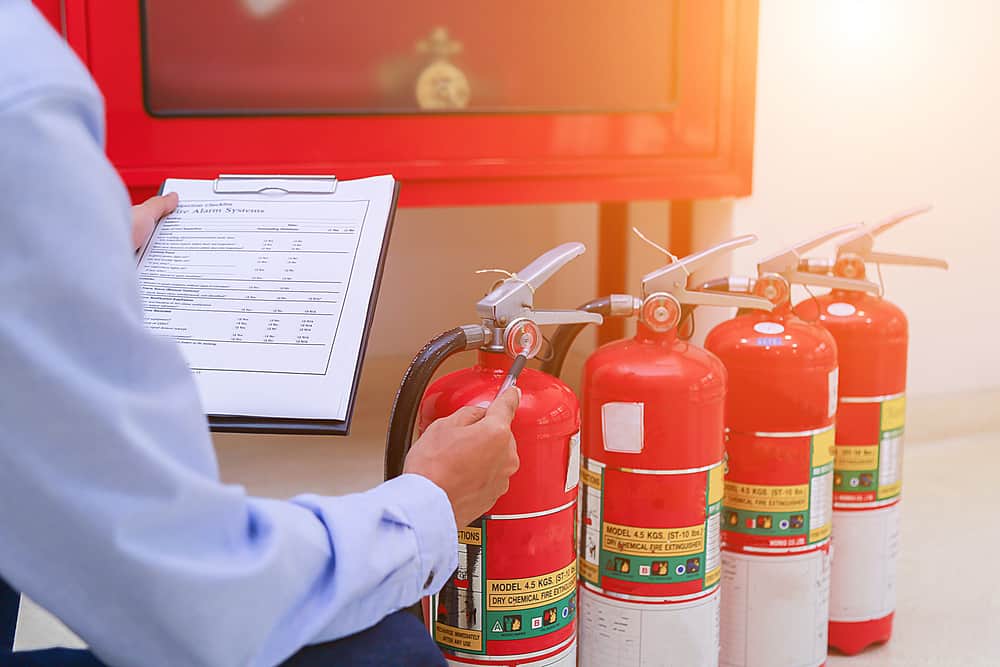
In New York City, the annual inspection must be performed by a company holding a valid FDNY Company Certificate and a technician holding a Certificate of Fitness (W-96). This isn’t a bureaucratic formality — it’s a hard requirement under 3 RCNY Section 115-02, the NYC fire code provision that governs portable fire extinguisher servicing. Using an unlicensed company, even one that does thorough work, leaves the extinguisher legally non-compliant.
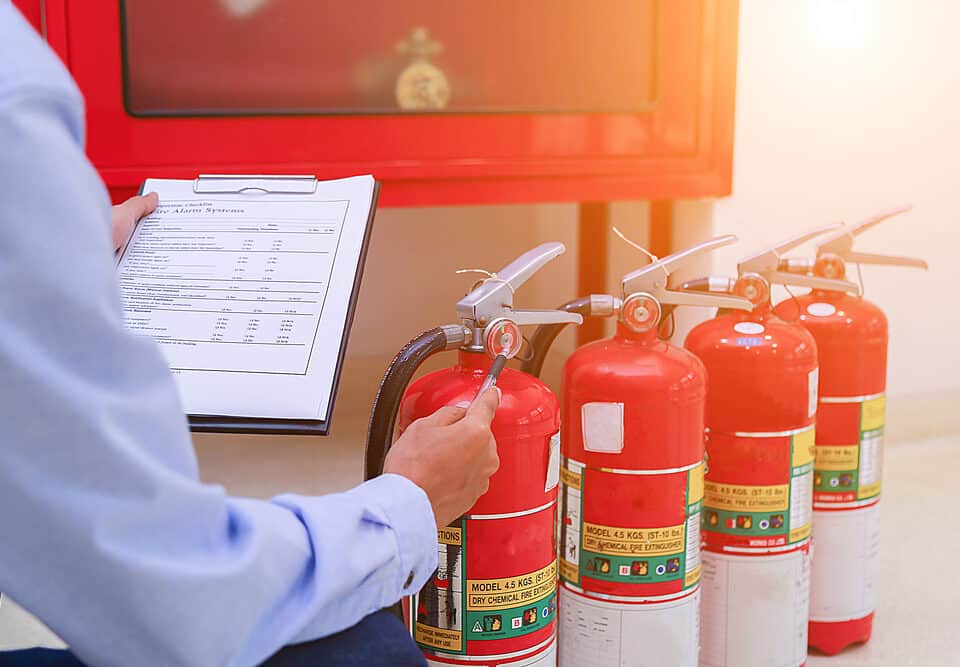
After 2019, the FDNY added another layer: every fire extinguisher in New York City must carry an FDNY-issued numbered Smart Tag after its annual service. These tags are only issued by FDNY-approved companies. There’s no workaround — a generic sticker or an out-of-state inspection certificate doesn’t satisfy this requirement. The Smart Tag is the physical proof that the annual service was performed by an authorized provider, and it’s one of the first things an FDNY inspector checks.
The annual inspection itself goes well beyond what the monthly visual check covers. The technician examines internal components, verifies the mechanical parts are functioning correctly, checks the agent and pressure, and may perform additional testing depending on the extinguisher type and age. Beyond the annual service, NFPA 10 also requires a 6-year internal examination — where the extinguisher is disassembled and inspected internally — and a 12-year hydrostatic test, which pressure-tests the cylinder shell itself. Most business owners have never heard of either of these, which is part of why having a reliable certified provider matters over the long term.
What Happens If You're Missing Inspection Records in NYC or Long Island?
The short answer: fines. In New York City, FDNY fines for failing to maintain properly inspected extinguishers range from $300 to $1,000 per extinguisher depending on the severity and frequency of the violation. Serious violations — particularly in high-occupancy settings — can reach $500 to $2,500. In Nassau County, first-time violations run $250 to $1,000 per unit. If you have five extinguishers and none of them have current inspection records, you’re looking at potential first-time exposure in the thousands of dollars.
What makes this particularly frustrating is that missing records generate the same violation as a broken extinguisher. A unit that’s fully charged, properly mounted, and in perfect physical condition can still produce a citation if the documentation isn’t in order. FDNY inspectors issue violations during emergency responses — not just scheduled inspections — which means there’s no reliable warning before an inspector walks through your door.
When a violation is issued, the property typically has 30 to 60 days to correct it before the Environmental Control Board issues a summons that triggers mandatory fines. That window sounds generous until you’re scrambling to find a certified provider, schedule service for multiple units, and get the paperwork squared away under time pressure. For businesses in Nassau County, Suffolk County, or any of the Five Boroughs, the smarter move is establishing a compliant inspection program before a violation forces the issue. That means completing the monthly log consistently, keeping the records on or with the unit, and scheduling annual professional service with an FDNY-approved company on a reliable cycle. The monthly form is the foundation — but it doesn’t replace the annual layer that keeps the full compliance picture intact.
Getting Your Fire Extinguisher Inspection Program Right in New York
The monthly fire extinguisher inspection form is a straightforward tool — a five-minute walkthrough, a few fields filled in, and a signature. What’s less straightforward is understanding where it fits in the larger compliance picture, and what it can’t cover on its own. The monthly log documents what your staff observes. The annual certified inspection documents what a trained technician verifies. Both are required. Both carry consequences if they’re missing.
If you’re in New York City or anywhere on Long Island and you’re not sure whether your extinguishers are fully current — monthly log, annual certification, FDNY Smart Tag, and all — that’s worth sorting out before an inspector does it for you. We at M&M Fire Extinguishers Sales & Services, Inc. have been handling fire extinguisher inspections, certifications, and FDNY violation removals across Nassau County, Suffolk County, and all Five Boroughs for over 35 years. If you have questions about your compliance status or need to schedule your annual service, reach out — we’re available around the clock and can often get to you the same day.
Related posts