Extinguisher Classes Explained: A, B, C, D, K Types
May 14, 2026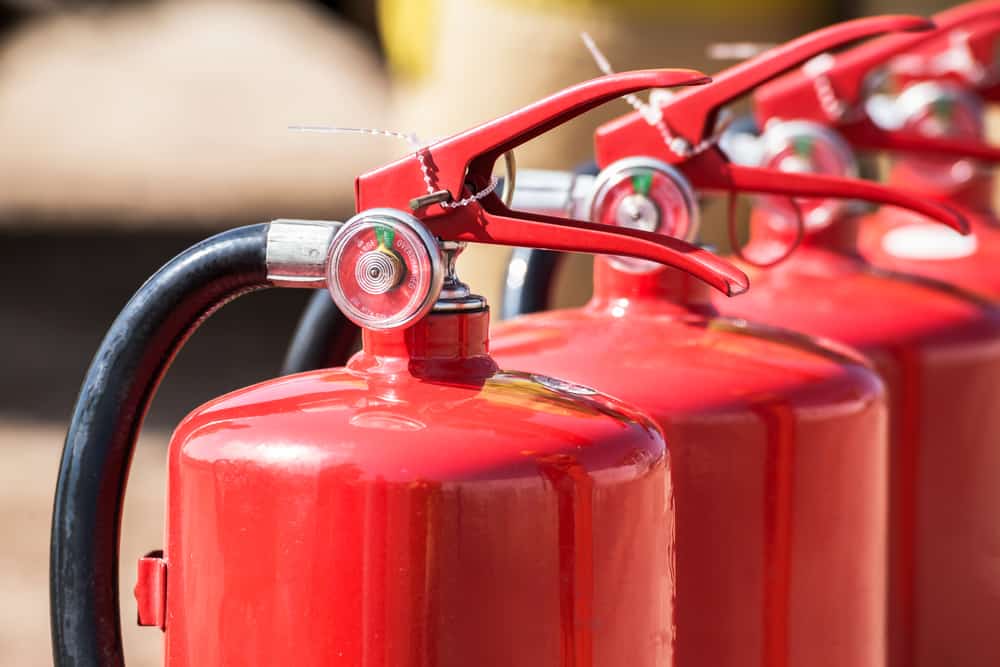
Fire Protection Equipment Types for Commercial Buildings
May 21, 2026
Summary:
You’re staring at your fire extinguisher’s pressure gauge and it’s not where it should be. Or maybe your annual inspection is coming up and you’re wondering what you’re actually going to pay this year. The cost to recharge a fire extinguisher isn’t complicated, but it’s also not always the right move. Sometimes replacement makes more sense. Sometimes you’re spending money on a unit that should’ve been swapped out two years ago.
Here’s what matters: knowing what you’ll actually pay in Nassau County in 2026, understanding when recharging is the smart choice versus buying new, and having a clear picture of your total fire safety costs so you can budget without surprises. Let’s break down the real numbers.
What Does It Cost to Recharge a Fire Extinguisher in 2026
The cost to recharge a fire extinguisher in Nassau County ranges from $20 to $80 per unit, depending on the size, type, and extinguishing agent. Standard ABC dry chemical extinguishers fall on the lower end of that range, while specialized units like CO2 or wet chemical extinguishers cost more.
That price covers depressurizing the unit, refilling it with the correct extinguishing agent, repressurizing to manufacturer specs, inspecting all components, and applying a new service tag. It’s not just topping it off. A proper recharge is a complete service process that ensures the extinguisher will actually work when you need it.
Most businesses across Long Island pay somewhere between $25 and $50 per extinguisher for a standard recharge. If you’ve got a dozen units across your facility, that adds up fast. But here’s the thing: not every extinguisher should be recharged. Sometimes replacement is cheaper, smarter, or required by code.
Fire Extinguisher Recharge Cost by Type and Size
Not all fire extinguishers cost the same to recharge. The type of extinguishing agent and the size of the unit directly affect what you’ll pay in Nassau County and throughout the Long Island area.
ABC dry chemical extinguishers are the most common in commercial settings. A standard 5 lb or 10 lb ABC unit typically costs $20 to $50 to recharge. These use monoammonium phosphate powder, which is relatively inexpensive and straightforward to refill. If you’re running a retail shop in Garden City, an office in Mineola, or a warehouse in Westbury, this is probably what you have mounted on your walls.
CO2 extinguishers cost more to recharge because carbon dioxide requires specialized handling and storage. Expect to pay $30 to $70 for a 10 lb CO2 unit. These are common in areas with sensitive electronics or server rooms where you can’t risk residue from a dry chemical extinguisher.
Wet chemical extinguishers, used primarily in commercial kitchens for Class K fires involving cooking oils and fats, are the most expensive to recharge. You’re looking at $50 to $100 per unit because the agent is specialized and the inspection process is more involved. If you operate a restaurant anywhere from Hempstead to Hicksville, this is a necessary cost you need to factor into your annual fire safety budget.
Here’s where size matters. Small 2.5 lb ABC extinguishers are often cheaper to replace than recharge. The labor and service costs don’t scale down proportionally, so you might pay $25 to recharge a unit that only costs $40 to $50 new. In those cases, replacement makes more financial sense.
Larger extinguishers, like 20 lb units, are almost always more economical to recharge. A new 20 lb extinguisher can cost $150 to $300, while recharging might only run $40 to $60. As long as the unit is in good condition with no rust, dents, or damage, recharging is the smarter move.
The other factor is whether your extinguisher even can be recharged. Disposable extinguishers with plastic valve assemblies aren’t designed for recharging. If you’ve got one of those, it’s a one-and-done situation. Check for a metal valve and a pressure gauge. If it’s got plastic components and no gauge, plan on replacement instead.
When Recharging Makes Sense vs When to Replace
The decision between recharging and replacing isn’t always obvious, but there are clear guidelines that’ll save you money and keep you compliant with Nassau County fire codes.
Recharge your fire extinguisher if it’s been used, even partially. Once you’ve pulled the pin and released any amount of pressure, the extinguisher needs to be recharged to be effective again. Even a small discharge compromises the internal pressure, and you can’t trust it to work properly next time.
You should also recharge if the pressure gauge shows it’s dropped into the red zone. That means it’s lost pressure over time, which can happen gradually even without use. If the unit is otherwise in good shape with no visible damage, a recharge brings it back to full functionality.
Here’s the timeline that catches people off guard: even if you’ve never used your fire extinguisher, NFPA 10 standards require stored pressure dry chemical extinguishers to undergo internal maintenance every six years and hydrostatic testing every twelve years. That six-year service involves a complete teardown, internal inspection, and recharge. It’s not optional if you want to stay compliant.
Now, when should you replace instead of recharge? If the extinguisher shows any signs of physical damage like rust, corrosion, dents, a broken handle, or a leaking nozzle, replacement is your only option. Recharging a damaged unit doesn’t make it safe. It just puts a fresh tag on equipment that could fail when you need it most.
Age matters too. Fire extinguishers over 12 years old should generally be replaced, even if they look fine. The internal components degrade over time, and older units may not meet current safety standards. If you can’t find the inspection tag or don’t know the service history, replacement is the safer bet. Without documentation, you have no idea if the extinguisher has been properly maintained or if it’s been sitting there losing pressure for years.
Cost comparison plays a role as well. For small 2.5 lb units, replacement often costs less than recharging when you factor in labor and service fees. For larger extinguishers in good condition, recharging is almost always more economical. A 10 lb or 20 lb unit that costs $100 to $300 new can be recharged for $30 to $60, making it a clear financial win.
The bottom line: recharge when the unit is structurally sound, properly sized for your needs, and within its service life. Replace when there’s damage, the unit is too old, the inspection history is missing, or the cost to recharge approaches the cost of buying new. If you’re not sure, we can inspect it and give you a straight answer. That’s what we’re here for.
Fire Extinguisher Costs: Inspections, Maintenance, and Total Ownership
The cost to recharge a fire extinguisher is just one piece of your total fire safety budget. To understand what you’re really spending, you need to account for inspections, periodic maintenance, and the eventual replacement of aging equipment.
Annual professional inspections in Nassau County typically cost $25 to $50 per extinguisher. This is separate from recharging. The inspector checks pressure levels, examines the exterior for damage, verifies the hose and nozzle are clear, and confirms the unit meets fire code requirements. They’ll apply a dated inspection tag that’s good for one year. Without that tag, you’re out of compliance, and FDNY fines can hit $300 to $1,000 per extinguisher.
You’re also required to perform monthly visual inspections yourself or have your staff do them. These are quick checks to confirm the extinguisher is in its designated location, the pressure gauge is in the green zone, the pin and seal are intact, and there’s no visible damage. Monthly inspections don’t cost money, but they do require time and documentation. Skipping them can lead to compliance issues during fire marshal visits.
Then there’s the six-year maintenance requirement. Every six years, stored pressure extinguishers must be emptied, internally inspected, and recharged. This is more involved than a standard recharge and typically costs more because it includes a complete teardown. Budget $40 to $80 per unit for this service. Add in the twelve-year hydrostatic testing requirement, and you start to see the full picture of fire extinguisher ownership costs over time.

Monthly Fire Extinguisher Inspection Requirements
Monthly fire extinguisher inspections are required by OSHA and are a critical part of staying compliant in Nassau County. These aren’t the same as annual professional inspections. They’re quick visual checks that you or your staff can perform in just a few minutes per unit.
Here’s what you need to check each month. First, confirm the extinguisher is in its designated location and hasn’t been moved or removed. It should be visible and easily accessible, not blocked by equipment, boxes, or furniture. If someone needs to grab it during an emergency, they shouldn’t have to move anything to reach it.
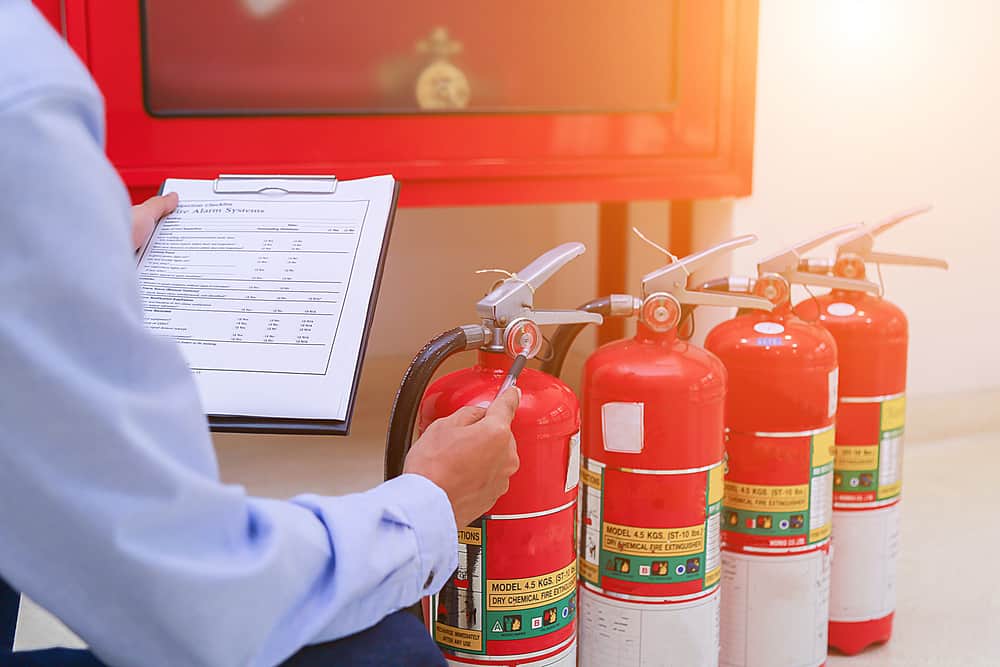
Next, check the pressure gauge. The needle should be in the green zone, which indicates the extinguisher is properly pressurized and ready for use. If the needle is in the left red zone, the unit is undercharged and needs recharging. If it’s in the right red zone, it’s overcharged, which is also a problem. Note that CO2 extinguishers don’t have pressure gauges, so you’ll need to check the weight instead, which is typically part of the annual professional inspection.
Verify the locking pin is intact and the tamper seal is unbroken. If the seal is missing or broken, someone may have used the extinguisher, or it could have been tampered with. Either way, it needs to be inspected and possibly recharged.
Look for any obvious physical damage. Check for rust, corrosion, dents, cracks in the hose, or a clogged nozzle. Any visible damage means the extinguisher should be taken out of service immediately and either repaired or replaced.
Finally, make sure the operating instructions on the label are legible and facing outward. If the label is faded, damaged, or covered, it needs to be replaced. In an emergency, someone unfamiliar with fire extinguishers needs to be able to read those instructions quickly.
You’re not required to keep formal records of monthly inspections, but it’s a smart practice. A simple log with the date, inspector’s initials, and any issues noted provides documentation if a fire marshal asks or if there’s an incident. Some businesses use a tag attached to each extinguisher where staff can initial each month. Others keep a digital or paper log. Either works as long as it’s consistent.
Monthly inspections take minimal time but catch problems before they become emergencies or compliance violations. If you find an issue during a monthly check, you can address it on your timeline instead of scrambling when the fire marshal shows up or, worse, when you actually need the extinguisher.
ABC Fire Extinguisher Uses and Why They're Common in Nassau County Businesses
ABC fire extinguishers are the most common type you’ll see in Nassau County commercial buildings, and there’s a good reason for that. They’re versatile, effective, and cover the three most common fire classes businesses face.
The “ABC” designation tells you what types of fires the extinguisher can handle. Class A fires involve ordinary combustibles like wood, paper, cardboard, cloth, and most plastics. Think office fires, storage areas, or retail spaces where you’ve got paper products, packaging materials, or wooden fixtures. Class A fires are the most common type in commercial settings.
Class B fires involve flammable liquids and gases. This includes gasoline, oil, grease, solvents, paints, and similar materials. If you’ve got a maintenance area, a loading dock with vehicles, or any space where flammable liquids are stored or used, you need protection against Class B fires.
Class C fires involve energized electrical equipment. Computers, servers, electrical panels, appliances, and any other equipment that’s plugged in or wired falls into this category. The key here is that the extinguishing agent must be non-conductive so it doesn’t electrocute the person using it. ABC extinguishers use a dry chemical powder that’s safe on electrical fires.
The agent inside ABC extinguishers is monoammonium phosphate, a dry chemical powder that works by smothering the fire and interrupting the chemical reaction that sustains combustion. When you discharge an ABC extinguisher, the powder coats the burning material, cutting off oxygen and cooling the fire. It’s effective and fast-acting, which is why it’s the go-to choice for general fire protection.
ABC extinguishers don’t work on everything, though. They’re not suitable for Class K fires involving cooking oils and fats in commercial kitchens. If you operate a restaurant in Nassau County, you need dedicated Class K extinguishers near cooking equipment. ABC extinguishers also shouldn’t be used on Class D fires involving combustible metals, but those are rare in most commercial settings.
For most Nassau County businesses, ABC extinguishers provide broad coverage with a single unit type. That simplifies your fire safety plan, reduces training complexity, and makes compliance easier. Instead of having different extinguisher types for different areas, you can standardize on ABC units throughout most of your facility.
That said, there are situations where specialized extinguishers make sense. Server rooms and data centers often use CO2 or clean agent extinguishers because they leave no residue that could damage sensitive electronics. Commercial kitchens require Class K extinguishers. But for general office space, retail floors, warehouses, and common areas, ABC extinguishers are the standard for a reason.
Making Smart Decisions About Fire Extinguisher Recharge Costs
Understanding the cost to recharge a fire extinguisher helps you budget accurately and make informed decisions about when to recharge versus replace. In Nassau County, you’re looking at $20 to $80 per unit depending on size and type, with most standard ABC extinguishers falling in the $25 to $50 range.
But cost isn’t the only factor. Recharge when the unit is in good condition and within its service life. Replace when there’s damage, the extinguisher is over 12 years old, or the inspection history is unknown. Factor in annual inspection costs, six-year maintenance requirements, and monthly visual checks to understand your total fire safety investment.
The goal isn’t to spend the least money possible. It’s to spend wisely on fire protection that actually works when you need it while staying compliant with Nassau County fire codes. If you’re unsure about the condition of your extinguishers or whether recharging makes sense for your situation, we provide free on-site estimates and expert guidance to help you make the right call.
Related posts