Kitchen Fire Suppression Systems: Monthly Checklist and Compliance
August 6, 2026
What Fire Extinguisher Service Actually Covers at Every Service Level
August 13, 2026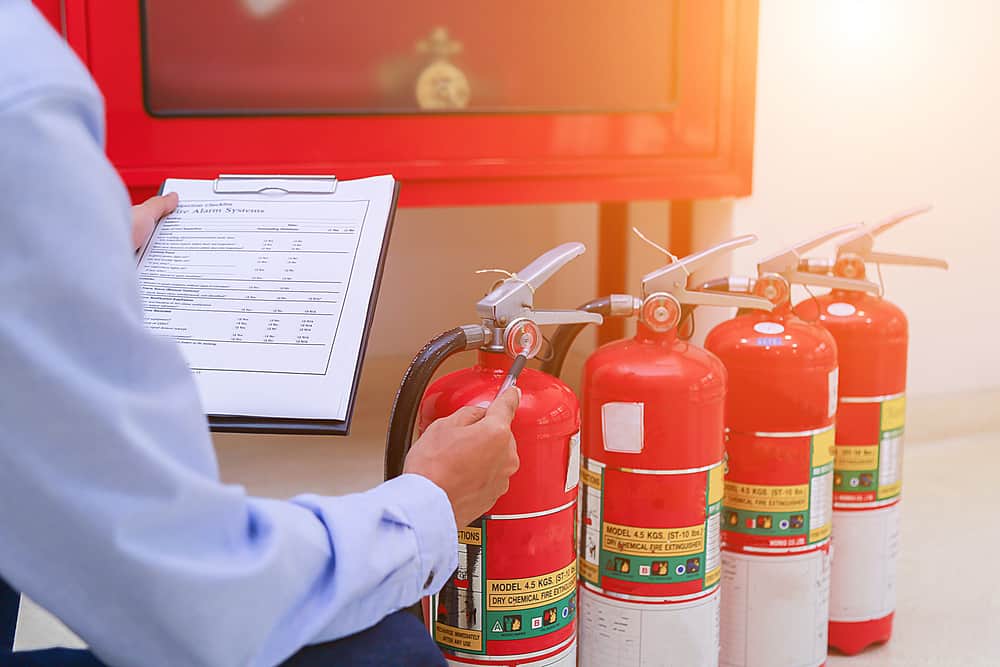
Summary:
If you run a business in Nassau County, NY, fire extinguisher inspection probably isn’t something you think about until you have to. A fire marshal shows up. Your insurance renewal requires documentation. You get a violation notice and suddenly need answers fast. The problem is, by the time most business owners start asking questions, they’re already behind. This guide covers what fire extinguisher inspection actually requires, how the rules work in Nassau County specifically, and what separates a legitimate inspection from one that leaves you exposed — even if someone came out and put a tag on your equipment.
Fire Extinguisher Inspection Frequency: Monthly, Annual, and Beyond
Most people think annual inspection is the whole story. It isn’t. NFPA 10 — the national standard for portable fire extinguishers — establishes a four-tier schedule that applies to virtually every commercial property in New York. Monthly visual checks, annual professional maintenance, a six-year internal examination, and a twelve-year hydrostatic test. Each tier has different requirements for who can perform it and what documentation it produces.
OSHA’s 29 CFR 1910.157 reinforces this. It requires monthly visual inspections and annual maintenance, and it requires employers to keep inspection records for at least one year. Missing any tier — even the monthly visual check — creates a compliance gap that OSHA and local fire marshals can cite.
Monthly Fire Extinguisher Checks: What They Cover and Who Can Do Them
The monthly visual inspection is the one tier your own staff can handle without a certified technician. NFPA 10 requires these checks at approximately 30-day intervals, and OSHA’s official guidance confirms that this interval is consistent with the standard. What the check actually involves: confirming the extinguisher is in its designated location, accessible, and not obstructed; verifying the pressure gauge reads in the green zone; checking that the safety pin and tamper seal are intact; looking for obvious physical damage, corrosion, or a clogged nozzle; and confirming the operating instructions on the nameplate are legible and facing outward.
It sounds straightforward, and it is — but “straightforward” doesn’t mean optional. If your monthly checks aren’t being done and documented, that’s a recordable gap. Fire marshals across Nassau County, NY inspect commercial properties on a rolling basis. If they find equipment that hasn’t been checked in months, the absence of documentation is itself a problem.
Fire extinguisher monthly inspection tags are the physical record of these checks. Each tag should show the date the inspection was performed and who performed it. This isn’t bureaucratic overkill — it’s the paper trail that demonstrates ongoing compliance, and it’s what a fire marshal looks at first. A tag that’s six months old on an extinguisher that’s supposed to be checked monthly tells a clear story, and it’s not the one you want to tell.
The monthly check is also where small problems get caught before they become expensive ones. A pressure gauge that’s drifted into the red zone, a tamper seal that’s been broken, a unit that’s been moved from its mounted location — these are fixable issues when caught early. Caught during a fire marshal inspection instead, they become violations.
Annual Fire Extinguisher Inspection and Certification: What a Certified Technician Actually Does
The annual inspection is where a certified technician takes over. This isn’t just a more thorough version of the monthly visual check — it’s a different category of service that produces different documentation and carries different legal weight. Under NFPA 10 and OSHA 29 CFR 1910.157, annual maintenance must be performed by a trained professional, and the resulting inspection tag and paperwork are what your business needs to demonstrate compliance to a fire marshal, an insurer, or an OSHA auditor.
What a proper annual inspection covers: pressure testing, internal component checks, hose and nozzle inspection, verification of the unit’s weight and fullness, tamper seal replacement, and a review of the nameplate and mounting hardware. The technician also affixes a new dated inspection tag and updates your documentation. In New York City, that tag must be an FDNY-mandated Smart Tag — a QR-coded label that fire marshals can scan to verify the inspection was performed by a licensed provider. After 2019, generic tags from non-approved companies are not compliant.
Here’s where Nassau County, NY businesses need to pay close attention. Nassau County falls under New York State Fire Code, enforced by the Nassau County Fire Marshal — not FDNY. These are separate licensing jurisdictions. A company licensed only to service fire extinguishers in New York City cannot legally perform certified inspections for Nassau County businesses. If you’re operating in Valley Stream, Hempstead, Hicksville, or anywhere else in Nassau County, NY, the provider you hire needs to hold the correct certification for this county specifically. Using a NYC-licensed-only provider means the tag on your extinguisher is invalid — even if the physical inspection was done correctly, even if you paid for it, and even if it looks legitimate. That’s a compliance failure waiting to be discovered.
Fire extinguisher inspection certification is the documentation package that proves the work was done by a qualified, licensed technician in the right jurisdiction. It’s not a formality. It’s what stands between your business and a violation.
FDNY Codes and Nassau County Fire Marshal Requirements: Understanding the Difference
This is the part that catches Nassau County, NY business owners off guard most often. FDNY has authority within the five NYC boroughs. Nassau County operates under a separate enforcement structure — the Nassau County Fire Marshal, applying New York State Fire Code. They are not interchangeable, and the licensing requirements for fire extinguisher service companies reflect that.
A provider must hold separate certifications for NYC, Nassau County, and Suffolk County. That’s three distinct licenses for three distinct jurisdictions. Many providers are licensed for one, some for two. Fewer hold all three. If you’re near the Queens or Brooklyn border — in Valley Stream, Elmont, or Lawrence — it’s easy to assume an NYC-licensed provider covers you. It doesn’t.

The Invalid Tag Problem: When You've Paid for an Inspection and You're Still in Violation
This scenario plays out more often than most business owners realize. A fire extinguisher service company comes out, performs what looks like a legitimate inspection, affixes a tag, and collects payment. The business owner assumes they’re covered. Then a fire marshal shows up, scans the tag, and the QR code doesn’t return a valid certification — or the inspector’s company isn’t licensed to operate in Nassau County, NY. The business receives a violation. The money spent on the “inspection” is gone, the tag is worthless, and now there’s paperwork to deal with on top of it.
FDNY violations for fire extinguisher non-compliance can range from $300 to $2,500 per extinguisher depending on the nature and severity of the violation. False certification under NYC Administrative Code Section 15-220.1 carries fines of $1,000 to $5,000. OSHA penalties for non-compliance can reach $16,500 per violation. These aren’t theoretical numbers — FDNY issued more than 22,000 violations across New York City in 2024 alone.
The only way to avoid this is to verify that the company you hire holds the correct license for your jurisdiction before they set foot in your building. For Nassau County, NY businesses, that means confirming Nassau County Fire Marshal certification, not just FDNY credentials. Ask for it directly. A legitimate provider will have no problem showing you.
FDNY violation removal is a separate service that not all providers offer. If your business has already received a violation, you need a company that can handle the documentation and correction process — not just the physical repair. Knowing how to fix the equipment is one thing. Knowing how to navigate the paperwork to get the violation cleared from your record is another.
OSHA Fire Extinguisher Requirements for Construction Sites in Nassau County
Construction sites operate under a different set of rules. OSHA 29 CFR 1926.150 — the construction-specific standard — requires portable fire extinguishers to be on-site and properly maintained from day one of a project, in accordance with NFPA 10. This applies to every active job site, regardless of size.
Nassau County, NY has significant active construction underway. Transit-oriented development projects in Mineola, Hicksville, and Freeport have expanded the number of active sites across the county, and each one carries its own fire protection compliance obligation. General contractors and project managers who assume fire extinguisher setup is something to handle later in the project timeline are taking on real OSHA exposure. A citation for missing or non-compliant extinguishers on a job site can result in penalties up to $16,500 per violation — and OSHA inspectors do conduct site visits.
What OSHA 1926 fire extinguisher requirements actually demand: extinguishers must be provided at each story of a building under construction where combustible materials are present, within 100 feet of any location where more than 5 gallons of flammable liquids are stored, and near any welding or cutting operations. They must be inspected periodically and maintained in accordance with NFPA 10. Documentation of those inspections must be kept on-site and available for review.
OSHA also has requirements for fire extinguishers in vehicles used on job sites. Any motor vehicle or motorized equipment used in a hazardous location must carry an appropriate extinguisher, properly mounted and accessible. This catches a lot of contractors off guard — it’s not just about the building under construction, it’s about the equipment being used to build it.
Getting fire extinguisher compliance right on a construction site isn’t complicated, but it does require working with a provider who understands the OSHA 1926 framework specifically, not just the general commercial inspection requirements. The setup, documentation, and ongoing inspection schedule for a job site is a different conversation than what a restaurant or office building needs.
Finding a Fire Extinguisher Inspection Company in Nassau County That's Actually Licensed for It
The right provider for a Nassau County, NY business isn’t just any company with a truck and a tag machine. It’s a company that holds the correct jurisdiction-specific license, understands the difference between FDNY requirements and Nassau County Fire Marshal enforcement, can produce documentation that holds up under audit, and has enough experience to handle situations beyond a standard annual inspection — violations, suppression systems, construction sites, industrial facilities.
That combination is less common than it should be. It’s worth asking about directly before you schedule anything.
We at M&M Fire Extinguishers Sales & Services, Inc. have been doing this work across Nassau County, NY, Suffolk County, and all five NYC boroughs for over 35 years as a family-owned operation. We hold the correct certifications for Nassau County and understand the specific requirements that apply to your business. If you have questions about your compliance status, need to address an existing violation, or just want to know where you actually stand, reach out — we’re available 24 hours a day and can come to you.
Related posts