
Class K Fire Extinguisher: Why No Other Type Works in a Commercial Kitchen
September 10, 2026
OSHA Fire Extinguisher Placement Rules, Decoded
September 11, 2026
Summary:
If you’re managing a construction project in Nassau County, fire extinguisher compliance probably isn’t the first thing on your mind when the job starts. But under OSHA’s rules, it has to be. There’s no grace period, no punch-list exception — the moment hazardous materials show up on your site, you’re already required to have compliant equipment in place.
Getting cited for something this fixable is a hard lesson. A single serious violation can cost $16,550 or more. This post lays out exactly what OSHA requires, where Nassau County adds its own layer, and what contractors most commonly get wrong before an inspector ever walks through the gate.
OSHA Fire Extinguisher Requirements for Construction Sites
The governing federal standard is 29 CFR 1926.150 — OSHA’s Subpart F on fire protection for construction, alteration, and demolition sites. It’s more specific than most contractors realize, and “we had extinguishers on site” isn’t enough to satisfy it.
The standard requires that extinguishers be listed or approved by a nationally recognized testing laboratory, conspicuously located and accessible, properly mounted, and documented with current inspection records. An extinguisher sitting on the floor in a storage trailer, without a tag, without a mount, doesn’t check the box — even if it works perfectly fine.
The rule also states clearly that as fire hazards occur, there shall be no delay in providing the necessary equipment. That language matters. It means Day One compliance isn’t optional.
OSHA 1926 Fire Extinguisher Requirements: Quantities, Placement, and Ratings
The specific placement and quantity rules live in 1926.150(c)(1), and they’re more granular than most people expect. For general construction areas, OSHA requires at least one 2-A rated extinguisher for every 3,000 square feet of protected building area. Travel distance to the nearest unit cannot exceed 100 feet — meaning a large open floor plate may require multiple extinguishers even if the square footage math says one would do.
That said, if your jurisdiction has adopted NFPA 10 — and New York State has — the stricter standard applies. NFPA 10 sets the maximum travel distance at 75 feet, not 100. That’s a meaningful difference on a sprawling commercial site or a multi-building residential development across Nassau County.
For flammable or combustible liquids, the requirement shifts. Wherever more than five gallons of flammable liquid or five pounds of flammable gas are being used, you need a 10-B rated extinguisher within 50 feet of that operation. Think about where your fuel is stored, where generators are running, where propane tanks are staged — each of those locations triggers this requirement independently.
Multi-story construction adds another layer. OSHA requires at least one extinguisher per floor, located adjacent to the stairway. On a five-story gut rehab in Hempstead or a new mixed-use building going up along Hempstead Turnpike, that’s five separate placement obligations before you’ve even accounted for square footage or flammable liquid storage.
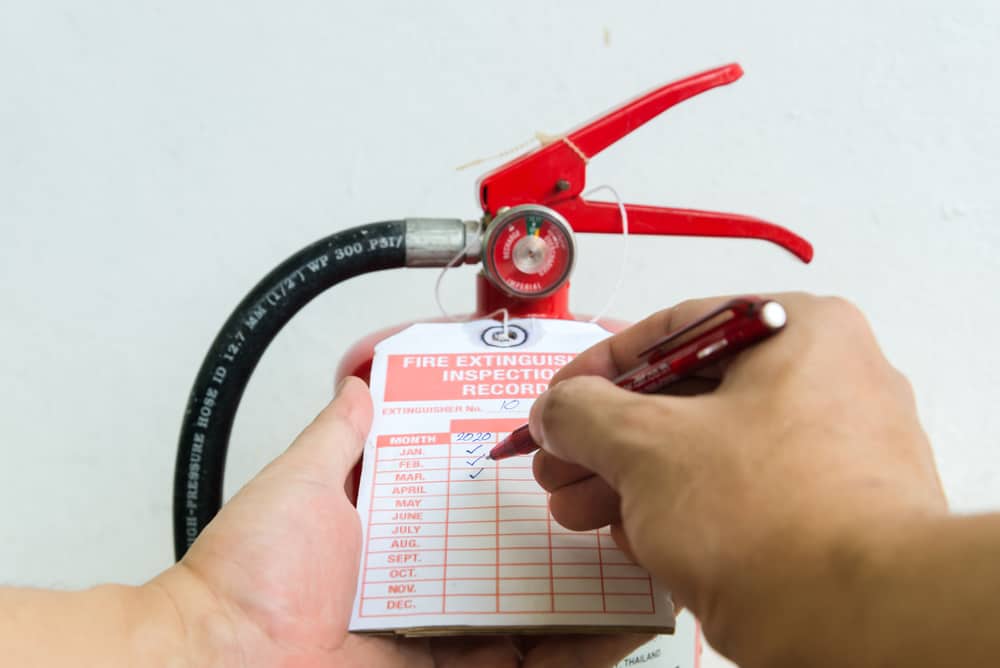
Inspections are not a once-a-year event, either. NFPA 10 — which OSHA 1926.150 explicitly references — requires periodic inspections at intervals not exceeding 31 days. Monthly visual checks are mandatory. The annual professional inspection is in addition to those, not instead of them. If an extinguisher gets discharged mid-project, it must be recharged or replaced immediately. A spent unit sitting in place is a violation, not a placeholder.
What Nassau County's Fire Prevention Ordinance Adds on Top of Federal OSHA
Here’s where a lot of contractors get caught. Federal OSHA sets the floor — but Nassau County has its own Fire Prevention Ordinance, and it applies to every construction project operating within the county. Section 5.12 of the Nassau County Fire Prevention Ordinance specifically addresses fire extinguishing equipment, and it establishes requirements for fire hazard control that run parallel to — and in some cases beyond — what 1926.150 requires.
The Nassau County Fire Marshal’s Office reviews contractor plan submissions for fire and life safety systems. If you’re pulling permits for a new structure, a tank installation, or an LPG setup — all common on active construction sites — that review process is part of your compliance picture, not a formality.
Municipalities within Nassau County enforce the ordinance at the local level too. The Village of Roslyn, for example, explicitly requires that fire protection equipment including portable fire extinguishers be maintained in proper operating condition at all times, and that all construction comply with the Nassau County Fire Prevention Ordinance. That’s not unusual — it reflects how enforcement actually works across Nassau County’s 64 incorporated villages and multiple townships.
If you’re also doing work across the county line into Queens, Brooklyn, or another NYC borough — which plenty of Nassau County contractors do — you’re also dealing with NYC Fire Code §1415.1. That standard requires approved portable fire extinguishers on floors where combustible materials are stored, where combustible waste is being generated, and at the entrance of each storage and construction shed. One provider, one set of compliance obligations across both jurisdictions, is a much cleaner way to operate than managing two separate vendors.
The point isn’t to overwhelm you with layers of regulation. It’s that contractors who only know 1926.150 are working with an incomplete picture when they’re operating in Nassau County — and that gap is exactly where citations happen.
OSHA Requirements for Fire Extinguishers in Vehicles and Equipment
The vehicle requirement is the one that catches site supervisors off guard most often. OSHA 1926.150(c)(1)(vi) requires a 10-B rated extinguisher within 50 feet of wherever more than five gallons of flammable or combustible liquid is in use — and that includes fueling operations, not just storage drums.
But there’s a common misread here that’s worth clearing up: the 10-B requirement does not apply to the integral fuel tanks of motor vehicles. Your truck’s built-in gas tank doesn’t trigger it. The requirement is about portable fuel storage and active fueling operations — the five-gallon jerry can, the portable fuel tank on a generator trailer, the fueling station for heavy equipment.
Do Construction Vehicles Need Fire Extinguishers Mounted on Them?
OSHA 1926.601 covers motor vehicle equipment on construction sites, and it lists fire extinguishers among the items that shall be checked at the beginning of each shift. That shift-check requirement applies to vehicles operating on the site — it’s not just a suggestion, and it’s not limited to heavy equipment.
The practical question contractors ask is whether every piece of equipment needs a mounted extinguisher. The answer depends on the vehicle’s function and what it’s operating near. A pickup truck driving across a site isn’t the same compliance situation as a fuel truck actively dispensing diesel to equipment. The 50-foot rule from 1926.150(c)(1)(vi) governs the fueling operation itself — meaning the extinguisher needs to be accessible within that radius during the operation, whether it’s mounted on the vehicle or staged nearby.
What matters for compliance is that the extinguisher is present, accessible, and in serviceable condition during operations — not that it’s bolted to a specific piece of equipment. If an inspector walks up to an active fueling operation and there’s no 10-B unit within 50 feet, that’s a citable condition regardless of what else is on site. Documentation matters here too: the shift-check requirement under 1926.601 implies a record of those checks, which means having a process, not just having equipment.
Penalties for Fire Extinguisher Non-Compliance
The penalty math is worth understanding before you decide this is something to handle later. A single serious OSHA violation for a fire extinguisher issue — an expired tag, a missing unit, an improperly mounted extinguisher — carries a maximum penalty of $16,550 per violation as of 2026. For willful or repeat violations, that number climbs to $165,514 per violation.
These are the published federal penalty schedules, adjusted annually for inflation. And “per violation” means per extinguisher, per location, per deficiency — not per inspection visit. A site with multiple compliance gaps doesn’t get one citation; it gets one per issue.
The cost of getting compliant extinguishers in place, properly inspected and documented, is a fraction of a single serious citation. A contractor running a 40-unit residential renovation in Garden City or a commercial build-out along Sunrise Highway is already managing tight margins. One OSHA citation for something this preventable doesn’t just cost the fine; it costs the delay, the paperwork, and the reputational hit with a general contractor or property owner.
There’s also the recharge obligation to factor in. If an extinguisher on your site gets used — even partially discharged — OSHA requires it to be replaced or recharged immediately. A spent unit left in place is itself a violation. That’s why having a service provider with same-day availability isn’t just convenient; it’s a compliance requirement waiting to be triggered.
Getting Fire Extinguisher Compliance Right in Nassau County
The requirements aren’t complicated once you see the full picture — but the full picture is what most contractors are missing. Federal OSHA under 1926.150 sets the baseline. NFPA 10 tightens the travel distance. Nassau County’s Fire Prevention Ordinance adds a local layer. And if your projects cross into NYC, you’re dealing with the Fire Code on top of all of it.
Getting it right means more than buying extinguishers. It means the right type, the right quantity, the right placement, proper mounting, current documentation, and a certified inspection on record before your site gets its first visit.
M&M Fire Extinguishers Sales & Services, Inc. has been handling exactly this for contractors across Nassau County, Suffolk County, and all five NYC boroughs for over 35 years. We understand the local ordinances, the inspection cycles, and the recharge timelines that keep your projects moving without citations.
If you’re starting a project and need to get compliant fast — or you’re not sure where your current setup stands — reach out for a free on-site estimate. We offer same-day and 24-hour service because compliance doesn’t always wait for business hours.
Related posts