
Prepare Your Facility for Fall Fire Safety
July 7, 2026
Fire Extinguisher Inspection Certification: Who Can Issue It in NY
July 9, 2026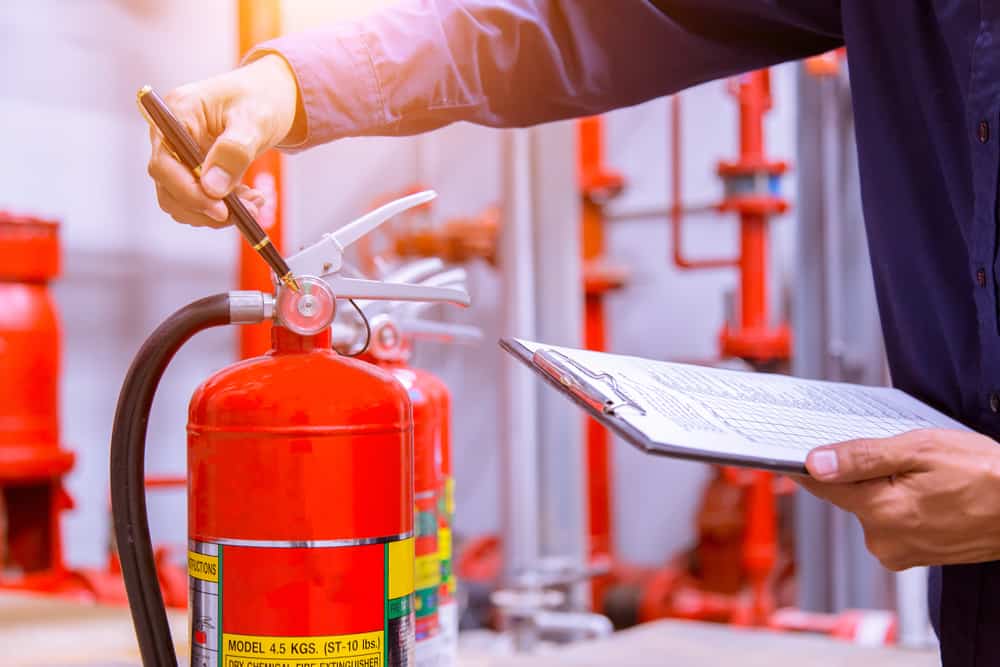
Summary:
If someone came to your business, inspected your fire extinguisher, and left a tag — you probably assumed you were covered. Most business owners do. But on Long Island, that assumption has cost dozens of businesses real money, real violations, and real liability. The fake fire extinguisher inspection tag scam is not a rumor. It has a name attached to it, a Suffolk County DA case number, and approximately 30 businesses that paid for inspections that meant nothing. Before your next fire marshal visit, it’s worth taking sixty seconds to look at the tag on your wall and ask: is this actually valid?
What a Legitimate Fire Extinguisher Inspection Tag Must Show
A valid fire extinguisher inspection tag is not just a piece of cardstock with a date on it. Under NFPA 10 — the national standard for portable fire extinguishers — and New York’s own regulatory requirements, a properly completed tag must include the name of the servicing company, the technician’s name, a license or certificate number, the date the service was performed, and the date the next service is due.
In New York City, the requirement goes further. Since November 15, 2018, every fire extinguisher in the five boroughs must carry an FDNY-issued, uniquely numbered tag — one that only FDNY-approved companies are permitted to purchase and affix. A tag that looks official but wasn’t issued through that system is not legally acceptable proof of inspection. It doesn’t matter what it says or how professional it looks.
How to Tell If the Tag on Your Extinguisher Is Real or Fake
Start with the basics. Does the tag include a company name, a technician name, and a license or certificate number? If any of those fields are blank, handwritten in a way that looks improvised, or filled with vague language like “certified technician” without an actual credential number, that’s a problem.
Next, verify the company. Nassau County maintains a publicly searchable list of licensed fire extinguisher service contractors at nassaucountyny.gov. Suffolk County has its own Fire Extinguisher Licensing Board. If the company that tagged your extinguisher isn’t on those lists, they weren’t legally authorized to perform the inspection — regardless of what they told you when they walked in.
For businesses in New York City, the FDNY maintains its own list of companies holding a Portable Fire Extinguisher Servicing Company Certificate. The individual technician also needs to personally hold an FDNY Certificate of Fitness — specifically the W-96 designation. Both the company and the technician must be credentialed. One without the other doesn’t satisfy the requirement.
Here’s what makes this especially important on Long Island: the scam operators know that most business owners don’t check. They count on it. A man named Michael Castellano operated under the name Liberty Fire Extinguisher Sales Co. and defrauded approximately 30 Long Island businesses in Suffolk County by charging $20 per extinguisher for inspections he wasn’t licensed to perform. He was eventually arrested and charged with first-degree scheme to defraud, first-degree falsifying business records, and petty larceny. The Suffolk County DA’s office handled the case. The businesses he targeted had tags on their extinguishers — tags that would have failed any legitimate inspection by a fire marshal.
The Nassau County Fire Marshal issued a separate public warning about what they described as “an uptick in Fire Extinguisher scams in the area,” specifically calling out the used extinguisher swap — where someone enters your business, claims your current unit is overdue for service, and sells you a refurbished used extinguisher as if it were new. Valley Stream and South Farmingdale fire departments both issued their own alerts about fraudulent vendors using false credentials to gain entry to local businesses.
If someone shows up at your door offering to inspect your extinguishers on the spot without a prior appointment, that’s the single biggest red flag in this space. Legitimate companies don’t cold-call their way into compliance work.
Why One License Does Not Cover All of Long Island and NYC
This is the part that catches a lot of business owners off guard, especially those with multiple locations. New York City, Nassau County, and Suffolk County each have their own licensing requirements for fire extinguisher service contractors. A company that holds an FDNY certificate is not automatically authorized to work in Nassau or Suffolk. A company licensed in Nassau County cannot legally service extinguishers in Suffolk without separate credentials from Suffolk County’s Fire Extinguisher Licensing Board.
What this means practically: if your business has a location in Midtown, one in Garden City, and one in Deer Park, the company servicing all three needs three separate active credentials. Most business owners assume that a “licensed” company is licensed everywhere. That’s not how it works in New York.
This matters for the tag on your wall because a tag from a company that isn’t licensed for your specific county is, by definition, a non-compliant tag. It doesn’t matter that the company is licensed somewhere. If they’re not licensed where your extinguisher is located, the inspection doesn’t count.
When you ask an inspector for their credentials, you’re entitled to see their company certificate and their individual Certificate of Fitness. In Nassau County, individuals who physically handle fire extinguishers must hold a valid Certificate of Fitness issued by the Nassau County Fire Marshal’s Office. In New York City, that’s the W-96. These are not the same credential, and a technician can hold one without the other. Ask specifically for the credential that applies to your location — and if they can’t produce it, don’t let them touch your equipment.
We’ve been serving Long Island and all five boroughs for over 35 years. We hold the credentials required for Nassau County, Suffolk County, and New York City. When our technicians show up, they can hand you documentation that you can verify against public records on the spot. That’s what legitimate service looks like.
Fire Extinguisher Inspection Checklist: What's Actually Required and When
One of the most common misconceptions we hear from Long Island business owners is that fire extinguisher compliance is just an annual thing — someone comes once a year, puts a tag on it, and you’re done until next year. That’s not accurate, and missing the monthly piece is one of the most common reasons businesses end up with violations they didn’t see coming.
NFPA 10 breaks inspection requirements into four categories: monthly visual inspections, annual professional maintenance, a 6-year internal examination for stored-pressure units, and hydrostatic testing every 12 years (or every 5 years for CO₂ units). The annual and longer-cycle work requires a certified technician. The monthly piece does not.

Monthly Fire Extinguisher Inspection: What Your Staff Should Be Checking
Monthly visual inspections can be performed by any competent staff member — you don’t need to call a professional every thirty days. But they do need to happen, they need to be documented, and the documentation needs to be kept for a minimum of three years under New York requirements.
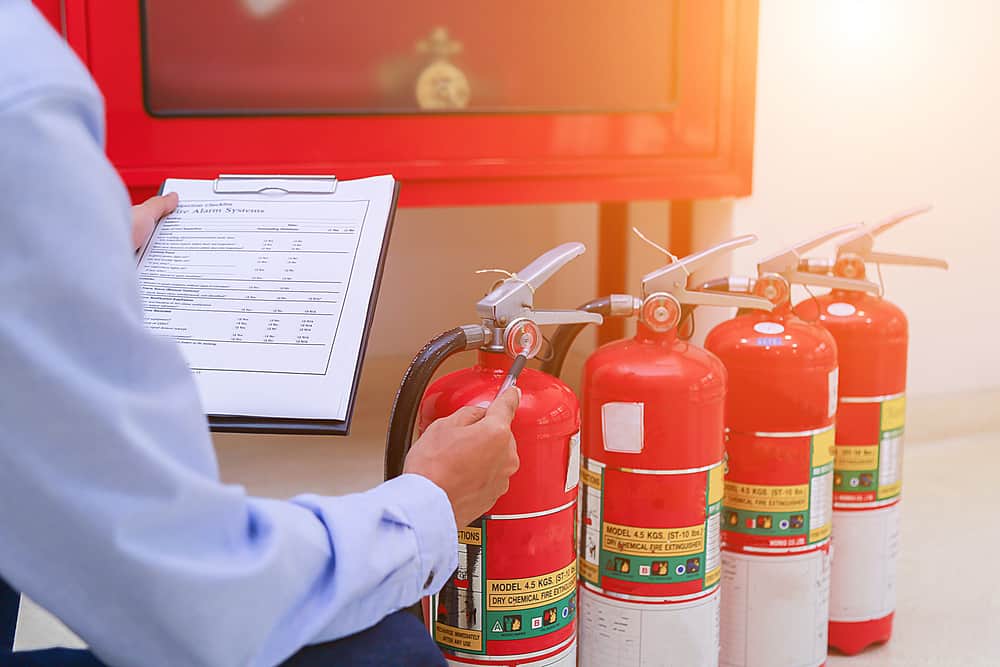
What does a monthly inspection actually involve? Walk to each extinguisher and confirm it’s in its designated location and hasn’t been moved or obstructed. Check that the pressure gauge needle is in the green zone — not in the red, and not pegged at zero. Verify the tamper seal and pull pin are intact. Look for any visible damage: dents, corrosion, leaking, or a clogged nozzle. Make sure the operating instructions on the label are still legible and facing outward.
Once you’ve confirmed all of that, initial and date the tag or your inspection log. That documentation is what protects you if a fire marshal or OSHA inspector asks for records. Under OSHA 29 CFR 1910.157(e)(3), businesses are required to maintain detailed inspection and maintenance records that are readily available for review. “I checked it and it looked fine” is not a record. A dated, initialed log entry is.
If anything looks off during a monthly check — low pressure, a missing seal, any visible damage — that’s when you call a professional. Don’t wait for the annual inspection date. An extinguisher that fails a monthly visual check needs to be serviced or replaced before it’s needed in an actual emergency.
Fire Extinguisher Audit Checklist for Multi-Location and Property Managers
If you manage more than one location — or if you’re a property manager responsible for multiple tenants — a single extinguisher check isn’t enough. You need a systematic fire extinguisher audit checklist that covers every unit across every property, with documentation that holds up to scrutiny from a fire marshal, an insurance adjuster, or an OSHA inspector.
Start by inventorying every extinguisher on each property: location, type (ABC dry chemical, CO₂, wet chemical/K-type), size, and the date of the last annual service. Then pull the tag on each unit and verify the following: Is the company name present? Is there a license or certificate number? Is the technician’s name listed? Is the service date within the last 12 months? Is the next service date noted? For any extinguisher in New York City, does the tag carry an FDNY-issued serial number?
Beyond the tag itself, confirm that each extinguisher is mounted correctly, accessible without obstruction, and has compliant signage identifying its location. OSHA has specific requirements for visibility and accessibility that go beyond what the fire marshal checks — and if you’re managing a commercial property with employees, both sets of requirements apply.
The jurisdictional layer matters here too. If your properties span Nassau County, Suffolk County, and New York City — which is common for property managers working the Long Island corridor — the company you use for annual service needs to hold active credentials in all three jurisdictions. If they don’t, some of your tags are non-compliant by default, regardless of when the inspection happened or how much you paid.
Keep a master log with each unit’s service history going back at least three years. New York requires that minimum, and having records beyond that gives you a cleaner paper trail if a dispute ever arises. A well-maintained audit file is also useful when your insurance carrier asks for proof of compliance at renewal — which they increasingly do.
How to Know Your Fire Extinguisher Inspection Tags Are Actually Valid
The tag on your extinguisher is the only thing standing between you and a violation when a fire marshal walks through your door. If it’s from an unlicensed company, missing required fields, or not FDNY-issued in a New York City location, it doesn’t matter that you paid for the inspection — you’re still non-compliant, and the fines run from $300 to $1,000 per extinguisher.
On Long Island, the scam risk is documented and ongoing. The Castellano case in Suffolk County and the Nassau County Fire Marshal’s formal warning aren’t isolated incidents — they reflect a pattern that targets businesses exactly like yours. The best defense is knowing what a real tag looks like, verifying your inspector’s credentials against the public records that exist for exactly that purpose, and working with a company that’s been doing this work in your county long enough to have a real track record.
If you’re not sure about the tags currently on your extinguishers, or if someone recently came to your business offering an inspection you didn’t schedule, reach out to M&M Fire Extinguishers Sales & Services, Inc. We’ve been serving Nassau County, Suffolk County, and all five boroughs for over 35 years, and we hold the credentials to back up every tag we affix.
Related posts