5 Fire Extinguisher Maintenance Records That Must Survive an Audit
July 23, 2026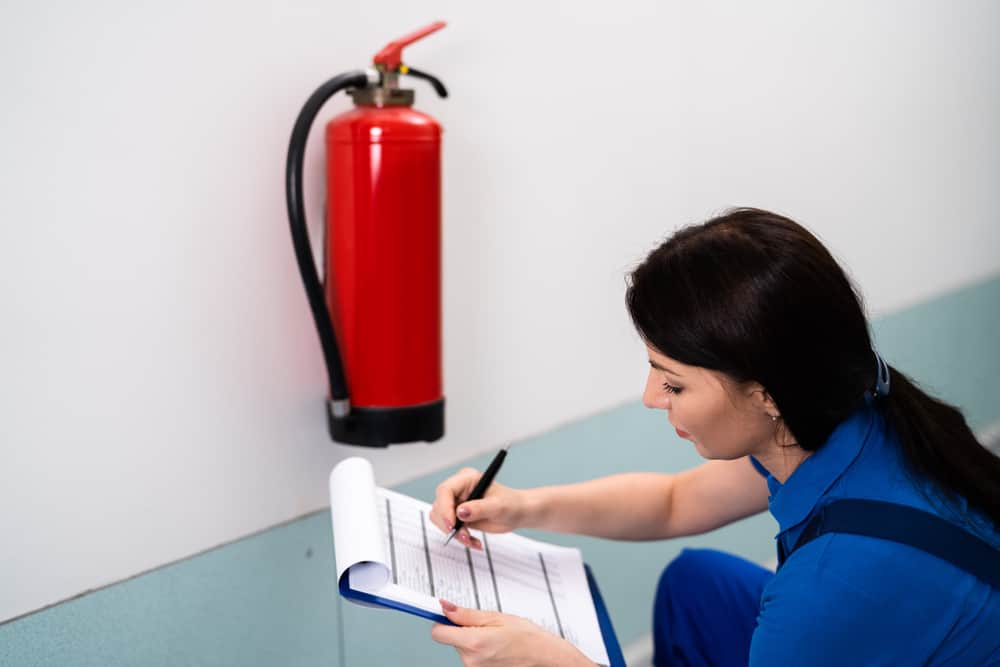
Summary:
You paid for an inspection. Someone came out, looked at your extinguishers, swapped the tags, and left. Everything looks fine. But here’s the question worth asking: do you actually know what a legitimate inspection tag is supposed to look like?
For a lot of business owners across Long Island and New York City, the honest answer is no — and that’s exactly what certain operators have been counting on. If you’re trying to figure out whether your current tags will hold up when the fire marshal walks in, you’re in the right place. What follows is a straightforward breakdown of what real compliance looks like, what the documented scam in this area looked like, and how to make sure you’re not holding a worthless piece of cardboard.
What a Legitimate Fire Extinguisher Inspection Tag Must Include
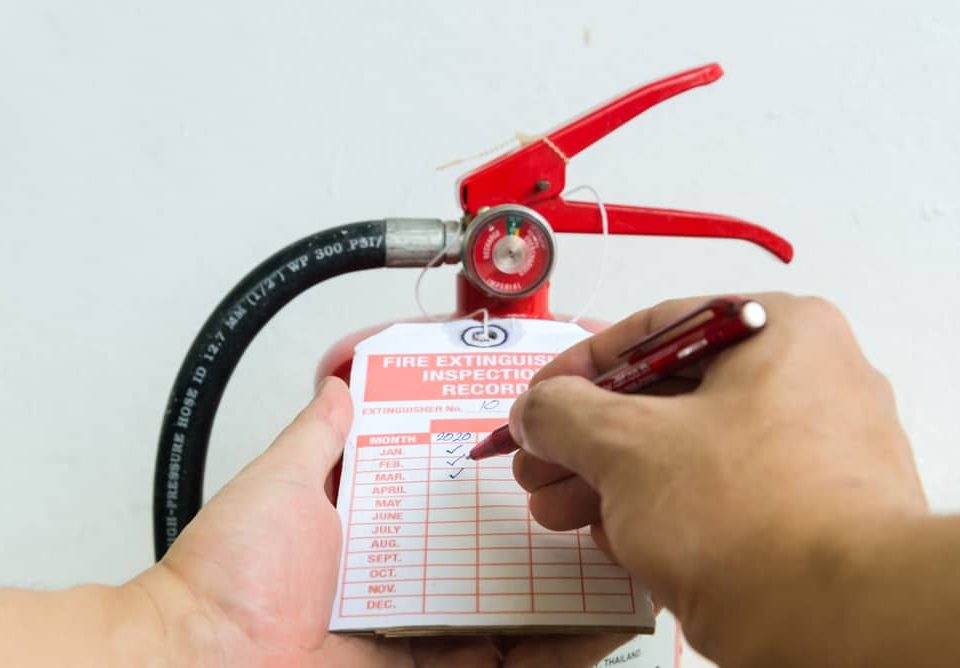
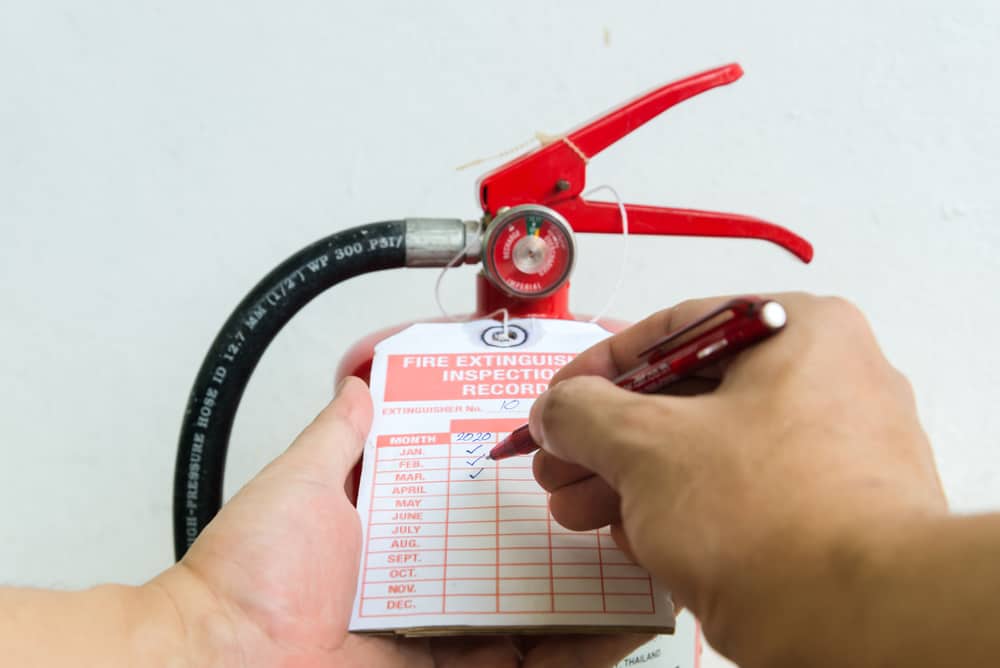
Under NFPA 10 — the national standard for portable fire extinguishers — every annual maintenance inspection must result in a service tag being physically attached to the extinguisher. That tag isn’t just a sticker. It’s an official compliance record, and it has to contain specific information to be considered valid.
At minimum, a legitimate tag must show the servicing company’s name, address, and phone number, along with a company ID, the date of service, the extinguisher’s serial number, model number, type classification, size, and the unit’s designated location in the building. If any of that is missing or vague, the tag doesn’t meet the standard — regardless of what someone told you when they handed you an invoice.
What Makes an FDNY Inspection Tag Different From a Standard Tag
If your business is located in New York City — any of the five boroughs — the requirements go further than NFPA 10. Under 3 RCNY Section 115-02, which took effect June 1, 2018, with full compliance required by October 1, 2019, the only tag FDNY will accept as proof of inspection is one issued directly by the FDNY to a licensed fire extinguisher service company.
These aren’t tags a company prints themselves or orders from a supplier. They’re issued by the city, numbered individually, and built with anti-counterfeiting features: a QR code that FDNY inspectors can scan on-site with a mobile device to verify the issuing company, a hologram, and a unique serial number. The old system — where companies used tags of varying sizes, shapes, and colors — made counterfeiting easy. The new system was specifically designed to close that gap.
Why did this change happen? Because the fraud was real, documented, and widespread enough that the city had to act. Inspectors were finding extinguishers with tags that looked legitimate but had been issued by unlicensed operators who never actually serviced the equipment. Buildings that thought they were compliant weren’t. And in some cases, those failures contributed to fires, injuries, and property loss.
The rule is straightforward: only companies that meet NYC licensing standards can purchase FDNY-issued tags. If your extinguisher has a tag that wasn’t issued through that system — even if it has a date, a company name, and looks professional — it is not acceptable proof of inspection under the NYC Fire Code. An FDNY inspector will flag it. You’ll get a violation. And the fact that you paid someone for an inspection won’t be a defense.
This is worth understanding clearly, because a lot of business owners assume that having any tag means they’re covered. In New York City, that assumption can cost you between $250 and $1,000 for a first offense, and significantly more for repeat violations. Serious cases can result in a vacate order.
The Counterfeit Tag Scam That Hit Nassau and Suffolk Counties
This isn’t a hypothetical risk. In August 2017, Suffolk County authorities charged Michael Castellano of a company called Liberty Fire Extinguisher Sales Co. with first-degree scheme to defraud, first-degree falsifying business records, and petty larceny. He had targeted approximately 30 businesses across Suffolk County, charging $20 per extinguisher, replacing tags without performing any actual service, and leaving business owners with fraudulent paperwork and extinguishers that had never been properly maintained.
The Suffolk County District Attorney’s office noted at the time that Castellano specifically targeted small businesses whose owners spoke English as a second language — people who were trying to do the right thing and had no way of knowing that what they were getting wasn’t legitimate.
Around the same time, the Nassau County Fire Marshal issued a public warning about an uptick in fire extinguisher scams in Nassau County. The pattern was similar: vendors would approach merchants directly, claim their extinguisher was out of date, and offer to swap it for what they described as a newer unit — which was often just a used extinguisher that had been cleaned up and re-tagged without any real service.
The reason these scams work is that a non-serviced extinguisher can look perfectly fine. The pressure gauge might read green. The pin is in place. Nothing looks wrong from the outside. But an extinguisher that hasn’t been properly maintained — with its internal components checked, its agent verified, and its mechanical parts inspected by a certified technician — can fail when you actually need it. And a business holding a fraudulent tag is in the same legal and insurance position as one that never scheduled an inspection at all.
Nassau County has its own licensing requirement separate from FDNY: anyone servicing fire extinguishers in Nassau County must hold a Certificate of Fitness issued by the Nassau County Office of the Fire Marshal and carry a photo ID card during service calls. If someone shows up at your door in Nassau County without that credential, they are not authorized to perform a compliant inspection.
Fire Extinguisher Inspection Record Tags vs. Monthly Inspection Tags
One thing that confuses a lot of business owners is the difference between the tag that gets attached after an annual professional inspection and the tags used for monthly visual checks. They are not the same thing, and they don’t carry the same legal weight.
The annual maintenance tag — the one a certified technician attaches after a full mechanical inspection — is what FDNY and insurance auditors are looking for. The monthly inspection tag is a separate record kept to satisfy OSHA requirements under 29 CFR 1910.157, and it can be completed by a trained employee on your staff. Both matter, but they serve different purposes and neither substitutes for the other.

What the Annual Inspection Actually Involves (and Why It Costs More Than $20)
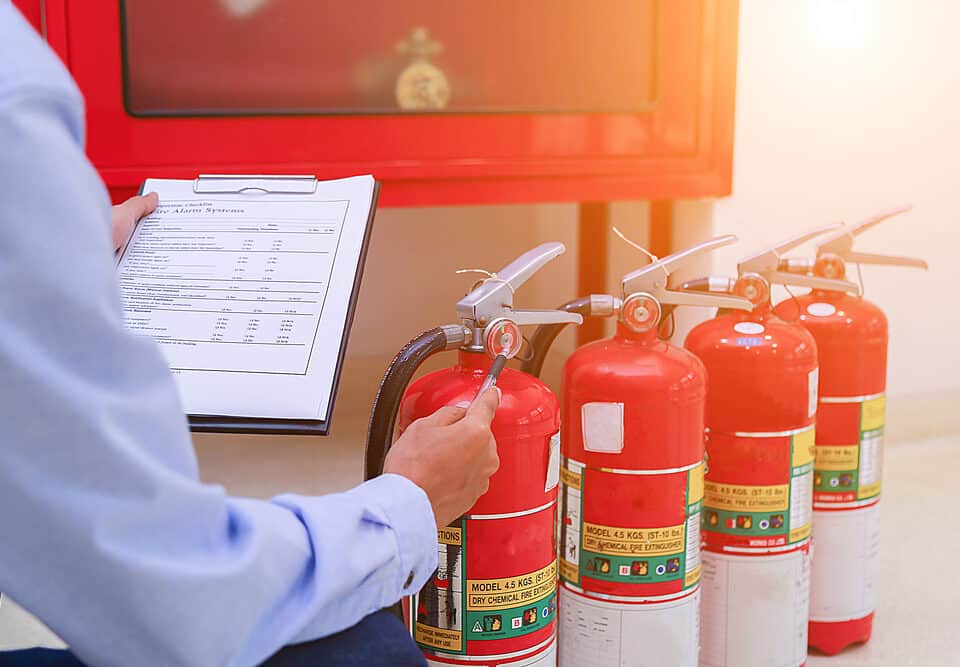
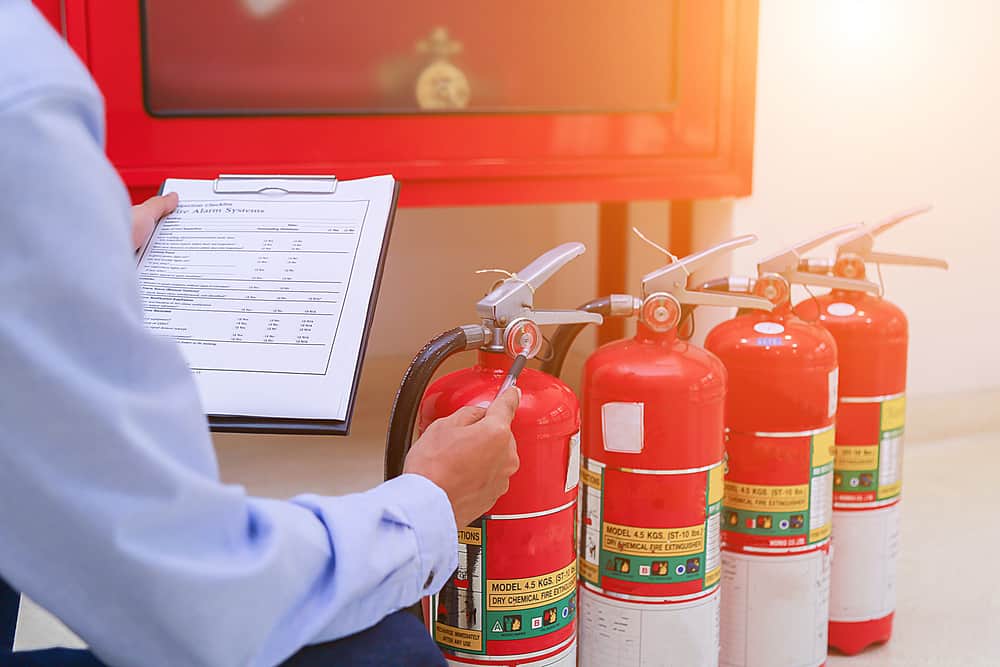
A legitimate annual fire extinguisher inspection isn’t a visual check. A certified technician is required to examine every mechanical component of the unit: the pressure gauge, the tamper seal, the pull pin, the discharge hose and nozzle, the handle and latch mechanism, the extinguishing agent condition, and the cylinder itself for signs of corrosion, dents, or damage. They verify that the unit is the correct type for its designated location and that it’s properly mounted. They check the weight to confirm the agent hasn’t been discharged or leaked. They document everything.
After that, they attach a new service tag with all the required information — and in New York City, that tag must be an FDNY-issued tag from a licensed company. In Nassau and Suffolk Counties, the technician must hold the appropriate Certificate of Fitness for those jurisdictions.
Beyond the annual inspection, NFPA 10 also requires a 6-year internal examination for stored-pressure extinguishers, during which the unit is fully emptied and the internal components are inspected and recorded on both the hanging tag and a separate metallic label. At the 12-year mark, a hydrostatic pressure test is required to verify the structural integrity of the cylinder. These aren’t optional — they’re part of the compliance cycle, and a service company that never mentions them is either skipping them or doesn’t know they exist.
A legitimate inspection takes time, requires training, and produces documentation that will hold up under FDNY scrutiny. If a price seems unusually low for the number of extinguishers being serviced, that’s worth questioning.
How to Read Your Current Tag and Know If It's Legitimate
If you’re looking at the tag on your extinguisher right now and wondering whether it’s real, here’s what to check. First, look for the company’s name, address, and phone number. If those aren’t clearly printed — or if the address doesn’t correspond to a real, verifiable local business — that’s a problem.
Second, check for a service date within the last 12 months. Third, look for the extinguisher’s serial number, model, type classification, and size. A tag that’s missing several of these fields wasn’t filled out correctly regardless of who issued it.
If your extinguisher is in a New York City location, the tag should have been issued by the FDNY — meaning it will have a unique serial number, a hologram, and a QR code. If you don’t see those features, the tag was not issued through the FDNY system and will not be accepted as proof of compliance.
For Nassau and Suffolk County locations, the technician who performed the inspection should have been carrying a Certificate of Fitness from the Nassau County Office of the Fire Marshal. If you can’t verify that the company servicing your extinguishers holds that credential, there’s no way to confirm the inspection was performed by an authorized technician.
One more thing worth knowing: the tag on the extinguisher is not the only record you’re required to keep. NFPA 10 requires that 12 consecutive months of monthly inspection records be maintained, and OSHA requires those records to be kept for at least one year. If you’ve never seen a monthly inspection log for your location, that’s a separate compliance gap from the annual tag — and both can come up during an FDNY inspection or an insurance audit.
If you’ve received an FDNY violation already, the clock is running. Violations must be corrected within 35 days to avoid a hearing and escalating penalties. That correction requires a legitimate re-inspection by a licensed company, followed by a Certificate of Correction filed with the FDNY. It’s a specific process, and not every service company knows how to navigate it.
What to Do If You're Not Sure Your Inspection Was Legitimate
If anything in this post made you look twice at the tag on your extinguisher, trust that instinct. The scam documented in Suffolk County and the warnings issued by the Nassau County Fire Marshal weren’t theoretical — they happened to real businesses in this area, owned by people who thought they were doing everything right.
A legitimate annual fire extinguisher inspection produces a tag with specific, verifiable information, issued by a company that is licensed to operate in your jurisdiction. In New York City, that means an FDNY-issued tag with a QR code, hologram, and serial number. In Nassau and Suffolk Counties, that means a technician with the appropriate Certificate of Fitness.
If you can’t confirm either of those things about your current service provider, it’s worth making a call before FDNY makes one for you. M&M Fire Extinguishers Sales & Services, Inc. has been serving Long Island and New York City for over 35 years. We’re family-owned, based in Deer Park, NY, and available 24 hours a day — including for businesses that have already received a violation and need it corrected fast.
If you have questions about your current tags or want to schedule an inspection you can actually stand behind, reach out to us directly.
Related posts