
Essential Summer Fire Hazard Inspection Guide
July 14, 2026
Fire Marshal Inspection Cost: What NY Businesses Really Pay
July 16, 2026
Summary:
Most business owners assume a fire marshal inspection is about the extinguishers on the wall. They’re not wrong — but they’re not entirely right either. The inspector is also looking at your paperwork, your exit routes, your signage, and whether the tag on that extinguisher was put there by a company we actually recognize as FDNY-approved. If any of those pieces are missing, you can have a perfectly functional extinguisher and still walk away with a violation. Here’s what a fire marshal inspection actually involves in New York, what you need to have ready, and how to make sure you’re not scrambling when they show up.
Annual Fire Extinguisher Inspection: What It Is and Why It Matters Before the Marshal Arrives
There’s a distinction most business owners don’t realize until it’s too late. The annual fire extinguisher inspection and the fire marshal inspection are two separate things. The annual inspection is performed by a certified service company — that’s us or someone like us — and it’s what produces the documentation the fire marshal will ask to see when they walk through your door.
Under NFPA 10, every portable fire extinguisher in a commercial space must be professionally inspected at least once every 12 months. That inspection has to be performed by a licensed technician, and in New York City specifically, it has to be done by a company on the FDNY’s approved list. The fire marshal doesn’t perform that service — they verify that you had it done, and done correctly.
Yearly Fire Extinguisher Inspection: What a Certified Technician Actually Does
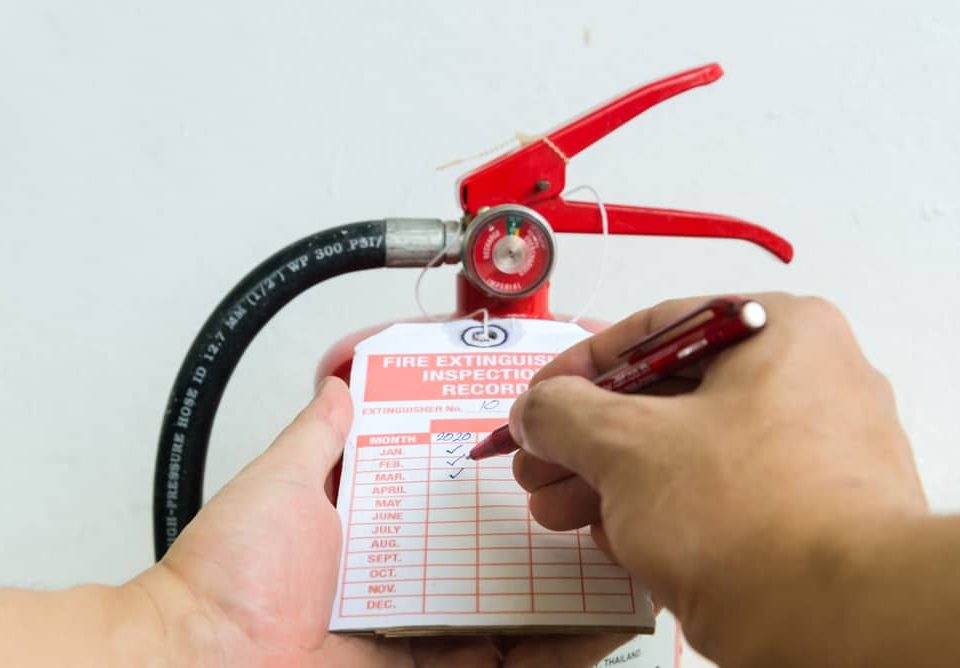
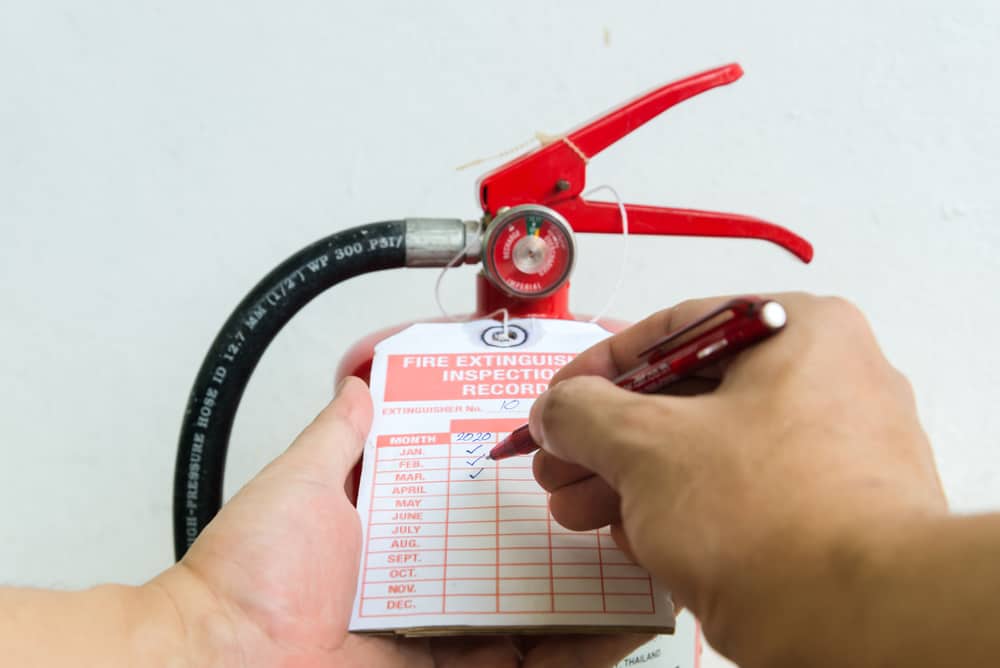
A thorough yearly fire extinguisher inspection is more involved than most people expect. A certified technician isn’t just glancing at the pressure gauge and swapping out the tag. They’re physically examining the shell, hose, nozzle, and handle for damage, corrosion, or wear. They’re testing the operating mechanism, verifying pressure levels, and checking the condition of the extinguishing agent.
They replace the tamper seal, confirm the nameplate and operating instructions are still legible, and verify that the unit is mounted correctly at the right height.
In New York City, the technician also affixes an FDNY-issued smart tag — a numbered tag with a QR code and hologram strip that’s unique to each extinguisher. This isn’t optional. Since October 2019, the FDNY has required these specific tags on every fire extinguisher in the five boroughs under rule 3 RCNY 115-02. Only companies on the FDNY’s approved list can purchase and affix them.
If your extinguisher has a generic inspection tag from a company that isn’t on that list, you are in violation — regardless of whether the physical inspection itself was done competently. This is one of the most common surprises for NYC business owners. They paid for an inspection, they have a tag on the wall, and they still get cited. The tag itself is the verification mechanism. When a fire marshal scans the QR code, it either comes back as a valid FDNY-issued tag or it doesn’t. There’s no gray area.
For businesses on Long Island — in Nassau or Suffolk County — the FDNY smart tag rule doesn’t apply in the same way, since those areas fall under New York State Fire Code rather than NYC Fire Code. But the requirement for annual professional inspection by a licensed technician is consistent across both jurisdictions, and the documentation standard is essentially the same. The fire marshal or code enforcement officer will still want to see a signed, dated service record from the most recent inspection.
Monthly Inspection of Fire Extinguishers: The Part That's Actually Your Responsibility
Here’s something a lot of business owners don’t know: you are personally responsible for inspecting your fire extinguishers every single month. Not your service company. You.
Under NFPA 10 and OSHA standard 29 CFR 1910.157, employers are required to conduct a monthly visual inspection of every portable fire extinguisher in the workplace. This isn’t the same as the annual professional inspection — it’s a quick visual check to confirm the extinguisher is in its designated location, isn’t obstructed, the tamper seal is intact, the pressure gauge is in the green, and there’s no obvious physical damage.
You document it, and you keep those records for at least a year. When a fire marshal walks in, they may ask for those monthly logs. Not just the annual service tag — the monthly records too. A business that can hand over a folder with 12 months of documented visual checks is in a very different position than one that’s never heard this requirement before.
The practical reality is that most small business owners aren’t doing this, and most don’t know they’re supposed to. The fire marshal knows that too. It’s one of the more common documentation gaps that turns what should be a routine inspection into a violation notice.
Setting up a simple monthly log doesn’t take long. It can be a dated entry in a binder kept near the extinguisher, or a digital record — the format doesn’t matter as much as the consistency. What the inspector wants to see is that someone in your building is paying attention to this equipment between annual service calls. If you’re not sure how to set that up, it’s worth asking your service technician to walk you through it when they come out for the annual inspection. That’s exactly the kind of thing we help businesses get right when we’re on site.
Fire Inspection Checklist: What the Fire Marshal Is Actually Looking At
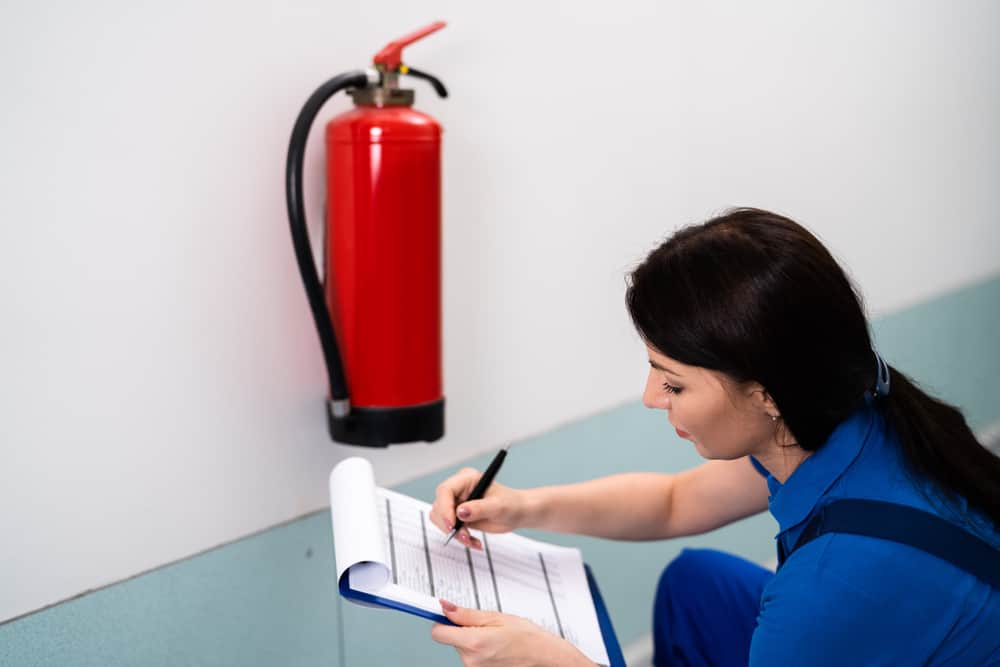
A fire marshal inspection in New York covers more than just your extinguishers. The inspector is doing a full assessment of your property’s fire safety compliance, and they’re working through a mental checklist that touches on equipment, placement, documentation, exits, and signage all at once.
Understanding what’s on that checklist is the difference between a business that passes and one that gets handed a Notice of Violation with a 30 to 90-day correction deadline — and potentially a fine ranging from $500 to $2,500 per violation for first-time FDNY citations in New York City.
What Fire Marshals Check: Equipment, Placement, and Compliance
On the equipment side, the fire marshal is looking at whether your extinguishers are the right type for the hazards present in your space. A restaurant kitchen with a commercial hood needs a wet chemical suppression system, not just a standard ABC dry chemical unit. An office environment has different requirements than a warehouse or a retail floor. Type mismatch is a real violation, and it’s one that surprises business owners who assumed one extinguisher type covered everything.
Placement and mounting are also closely scrutinized. Under NFPA 10 and FDNY Fire Code section 906, the maximum travel distance to a fire extinguisher for Class A hazards is 75 feet. For Class B hazards, that drops to 30 to 50 feet depending on the severity rating. Extinguishers weighing 40 pounds or less must be mounted with the top of the unit no higher than five feet from the floor. Heavier units must be mounted no higher than three and a half feet.
If your extinguisher is sitting on the floor in a corner or mounted too high to reach quickly, that’s a violation. The inspector will also check that the extinguisher isn’t obstructed. A box pushed in front of it, a piece of equipment blocking access, or a storage shelf that’s crept in front of the mounting bracket — these are all problems. The extinguisher needs to be visible, accessible, and clearly marked with the appropriate signage.
Beyond extinguishers, the fire marshal is checking exit paths, exit signs, emergency lighting, fire doors, fire alarm panels, and in commercial kitchens, hood suppression systems. Exits must be unobstructed with a clear 36-inch path, and exit signs must be lit and visible. Fire doors must close and latch properly — a fire door propped open with a wedge is a common violation in busy commercial spaces. These aren’t extinguisher issues, but they’re part of the same inspection, and they can generate violations independently.
The Documentation the Fire Marshal Will Ask For on the Spot
This is where a lot of businesses get caught. The physical equipment passes. The extinguishers are mounted correctly, the right type, the right size. And then the inspector asks for the folder — and there isn’t one.
At a minimum, a fire marshal in New York will want to see your annual fire extinguisher service records from the most recent inspection, your monthly visual inspection logs, and in New York City, documentation that your technician holds a valid FDNY Certificate of Fitness. For restaurants and commercial kitchens, they’ll also want records from your most recent hood suppression system inspection, which is required twice a year under FDNY requirements. If your building has a fire alarm system or a sprinkler system, those testing and inspection records may be requested as well.
In New York City, the FDNY also requires businesses to have an Emergency Action Plan — a documented evacuation procedure for your specific space. If you don’t have one, or if it hasn’t been updated since you moved in or changed your layout, that’s a documentation gap the inspector may flag.
The practical advice here is straightforward: keep a dedicated folder — physical or digital — that holds all of this in one place. Annual service records, monthly logs, hood suppression reports, alarm testing records, EAP. When the fire marshal arrives, you hand them the folder. That’s the difference between a five-minute inspection and a two-hour headache.
One thing worth knowing about New York City specifically: fire marshals here are not code enforcement officers in the traditional sense. They are armed police officers with full powers of arrest. The FDNY employs approximately 140 of them across the city. Unannounced, complaint-driven inspections are a regular part of how the system works. You may get 24 hours’ notice for a scheduled inspection — or you may get none at all. The businesses that handle these inspections without incident are the ones that maintain compliance year-round, not the ones that scramble when they hear a knock at the door.
How to Be Ready for a Fire Marshal Inspection in New York
The businesses that pass fire marshal inspections in New York without incident share one thing in common: they didn’t wait until the inspector was in the parking lot. They had their annual inspection done on time, by an approved company, with the right documentation. They understood their monthly inspection responsibility. And they kept their records organized.
If you’re not sure where you stand right now — whether your current service provider is FDNY-approved, whether your tags are valid, or whether your documentation would hold up — that’s worth finding out before the fire marshal does it for you.
M&M Fire Extinguishers Sales & Services, Inc. has been doing this work in New York City and Long Island for over 35 years. We’re family-owned, FDNY-approved, and available around the clock — including same-day service for businesses facing a violation deadline. If you want to know where you actually stand, reach out and we’ll take a look.
Related posts